PBOC Signals Comfort With Yuan Levels, Expects Two-Way Moves
China’s central bank signaled a preference for a flexible yuan, indicating little willingness to engineer the sharp appreciation demanded by some of the nation’s key trading partners.
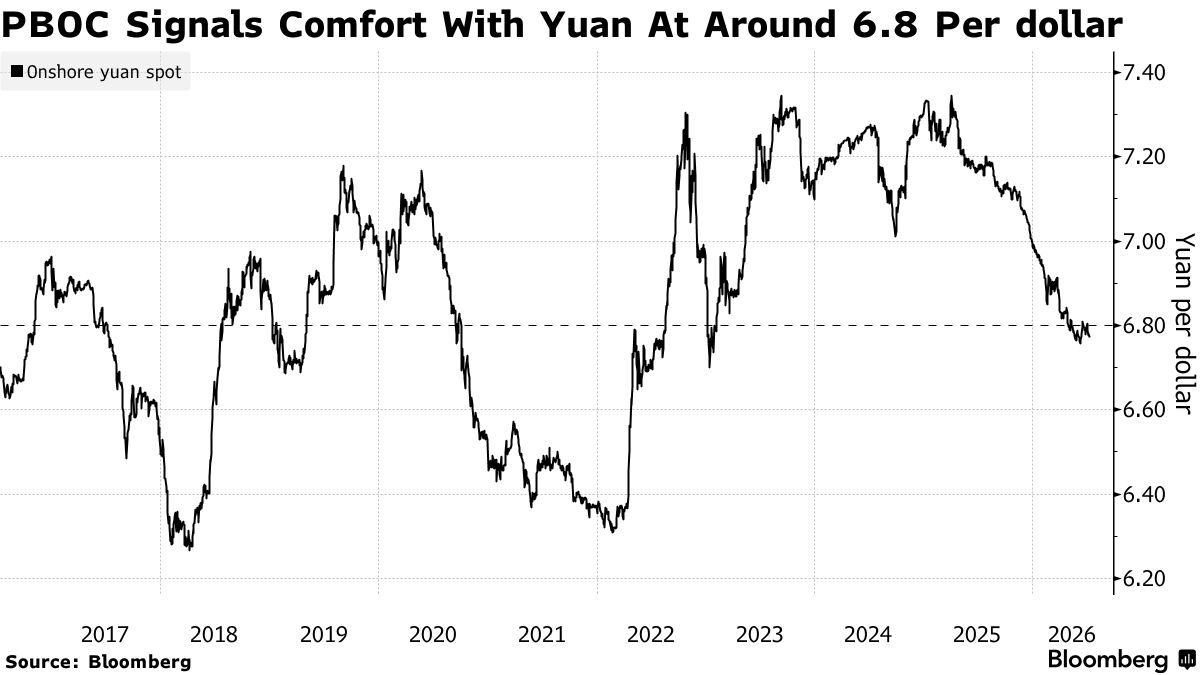
The yuan is currently hovering around 6.8 per dollar, a median level seen over the past few years, and factors exist that could lead to either a stronger or weaker currency going forward, Zou Lan , deputy governor of the People’s Bank of China, said at a briefing on Wednesday. The yuan will continue to see two-way moves, and the PBOC will ensure the market plays a key role in determining the currency’s rate, he added.
The remarks come as traders map out the yuan’s next move after its stellar run this year. The currency has gained about 3% since end-December to outperform all its Asian peers. It has advanced roughly 6% against the euro and over 4% against a basket of 24 trading partners’ currencies.
Earlier on Wednesday, the PBOC boosted the yuan’s daily reference rate by the most since April, signaling a greater tolerance for the currency’s strength. The so-called fixing limits the onshore yuan’s move by 2% on either side.
However, a slowing economy is tempering bullish yuan bets. The nation’s gross domestic product grew last quarter from a year ago, falling unexpectedly below the bottom of this year’s official target range of 4.5% to 5%.
The yuan’s rally has slowed in recent weeks as the dollar regained its upward momentum amid speculation that the Federal Reserve may soon raise interest rates to contain inflation. Higher oil prices have also driven up global bond yields and widened the gap between overseas and Chinese yields, threatening to trigger capital outflows.
The yuan’s appreciation versus the dollar and the basket of its trading partners’ currencies in the first half of the year is a result of market supply and demand and reflects confidence in the Chinese economy, Zou said. But tensions in the Middle East and uncertainties surrounding policies of major economies are complicating the near-term outlook, he added.
Zou indicated little willingness to see a large appreciation in the yuan amid calls from some of China’s trading partners for such a move.
German Chancellor Friedrich Merz proposed a political currency dialogue with Beijing in a speech on Monday, and said the yuan has been undervalued by 25% “ .” China’s customs data released Tuesday showed the nation’s trade surplus with both the European Union and Germany climbed to fresh in June.
Separately, Zou pushed back against speculation that the central bank was planning to replace the benchmark seven-day reverse repo rate with a shorter tenor rate. The newly introduced overnight reverse repo would mainly be used to address short-term liquidity needs, he said, adding that the PBOC will increase the frequency of the overnight operations in future.