Japan’s FX Chief Flags Contact With US, Intervention Impact
Japan’s currency chief suggested intervention was an effective strategy and flagged close communication between Tokyo and Washington over foreign exchange, in comments made as the yen hovers near a four-decade low.
“Judging from how the market moved afterward, I think it clearly had meaning,” Atsushi Mimura , Japan’s vice finance minister for international affairs, said of Tokyo’s last entry into the market two months ago during an interview with Bloomberg on Wednesday.
He also indicated that Japan did not hit a wall of opposition from the US over its entry into the market at that time.
“I’m not aware of the US ever making a single comment expressing disagreement with what we did, and if anything, there have actually been comments that were more supportive,” he said.
Mimura emphasized the frequency of his contact with officials in Washington, saying, “with phone calls and emails, I’m in touch with my counterpart far more frequently than most people probably imagine.”
Mimura spoke after the yen slid against the dollar to a fresh , creating the risk of faster inflation in a country that imports the bulk of its energy and more than half of its food.
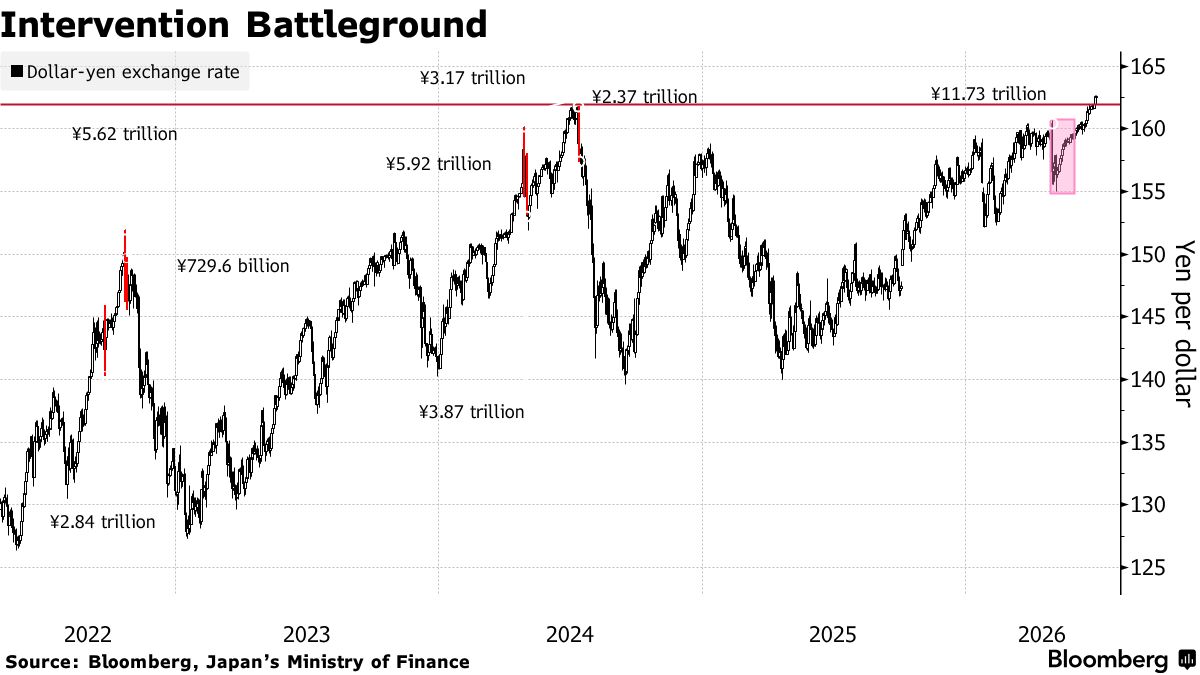
The yen was trading around 162.70 to the dollar Wednesday afternoon in Tokyo, near the weakest level since 1986.
Mimura’s remarks indicate that he continues to see intervention as a useful tool to stem excessive moves in the currency market and that the US is still largely on the same page regarding Tokyo’s foreign exchange policy. His comments come as market participants remain wary of the possibility of intervention by Japan’s authorities. US labor data out Thursday and a holiday weekend ahead may provide Tokyo with an opportunity to step in again to support the yen.
In the interview, Mimura refrained from spelling out the Finance Ministry’s standard currency stance, including its readiness at any time to take “bold action” — meaning intervention. While that reticence suggests authorities may be willing to let the currency fall further before acting, it may also be an attempt to retain a degree of surprise in the event authorities decide to step into the market again in the coming days.
Read more:
Still, with authorities apparently toning down their rhetoric, some market participants see an exchange rate of 164 to 165 per dollar as the next possible trigger for intervention — still some distance from the current level.
Japan a record ¥11.73 trillion ($72.1 billion) in the month through May 27 to prop up the yen, according to Finance Ministry figures. The ministry first stepped into the market on April 30, according to people familiar with the matter, when Japan’s currency was approaching the 161 threshold. Traders also suspect that Tokyo took further rounds of action in early May.
Japan’s currency initially strengthened, moving to around 155 per dollar, but steadily retraced those gains even after the Bank of Japan raised its benchmark interest rate to the highest in 31 years on June 16.
While Mimura characterized the action as significant, the loss of those gains and the further slide in the currency presents policymakers in Tokyo with the dilemma of how often they should carry out further action when each move is likely to become more costly or less powerful.
The FX chief’s reference to his regular contact with the US may give some investors in the market pause for thought.
Mimura’s boss, Finance Minister Satsuki Katayama , said she with US Treasury Secretary Scott Bessent last week, pointing to strengthened cooperation and alignment. That gave the yen a short-lived boost amid the intervention speculation.
Following his visit to Tokyo in May, Bessent also touted the countries’ close communication, describing it as “constant and robust.” Bessent has suggested he would prefer to see the yen reach appropriate levels as the BOJ conducts policy with a free hand rather than by intervention, but he also coordinated with Tokyo to help firm up the yen earlier in the year.
Read more:
In January, Bessent’s Treasury had the New York Federal Reserve check the yen exchange rate in a move that at the time spooked speculators into thinking that a coordinated intervention with the US might be in the works. That helped strengthen the yen without Tokyo or Washington actually entering the market, an indication of the extra fear factor for market players generated by US involvement.
Further cooperation from the US might help buttress any renewed entry into the market by Japan.
Behind the yen’s persistent weakness is growing speculation that the interest-rate gap between the US and Japan could widen again, with investors expecting the Federal Reserve to pivot to raising interest rates later this year.
“Looking at the latest US dot plot, I don’t read it as signaling two or three additional rate hikes,” Mimura said, adding that he was not in a position to comment on the policy direction of another country’s central bank.
Weakness in the yen threatens to amplify inflationary pressure in Japan, eroding households’ spending power. While corporate sentiment has stayed resilient, as exporters benefit directly from enhanced competitiveness, suppliers and domestic-oriented firms are squeezed by higher import prices and are increasingly passing on rising costs to customers.
Confidence among large manufacturers rose in June to the since 2018, while sentiment at large non-manufacturers was the most optimistic since 1991, the central bank said earlier Wednesday. But inflation expectations among those firms also rose to the highest levels on record.
Prime Minister Sanae Takaichi has sought to placate consumers by rolling out subsidies to cap fuel costs, but the strategy comes with downsides. Earlier this year, Takaichi’s proposal for a costly sales tax cut helped Japanese government bond yields, contributing to a broader global bond selloff.
Still, Mimura said none of his overseas counterparts have ever directly expressed concern about Japan’s , pushing back against market views that Takaichi’s spending agenda could undermine the country’s fiscal sustainability and further boost bond yields. He added that International Monetary Fund reports suggest Japan’s fiscal position has been recently viewed more favorably internationally.
Mimura has spent the past two years in one of the ministry’s top posts, helping steer US-Japan trade negotiations, overseeing the of Japan’s foreign investment screening framework and navigating challenges like the conflict in the Middle East. Throughout his career, he said his top priority has been ensuring Japan “plays its role and maintains a strong presence” on the global stage.
Asked about his thoughts for a potential third term, Mimura brushed aside the question with a World Cup analogy. “When Japan was playing Sweden in the group stage, I don’t think the team was thinking about a match against Brazil,” he said. “You simply do what needs to be done in the position you’re in.”