Barclays Sees Forint Rally Over as Tough Road to Euro Starts
The forint rally triggered by Hungary’s political shift is fading as Prime Minister Peter Magyar faces a daunting task to prepare the country for euro accession, according to a strategist at Barclays Plc.
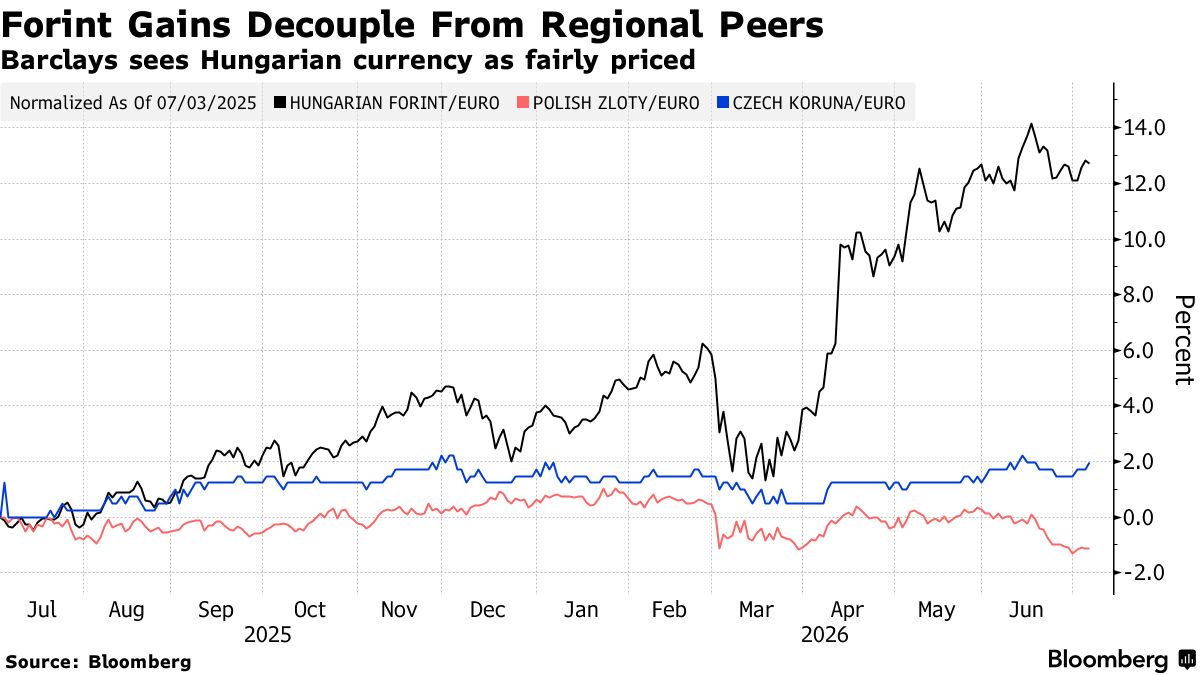
Strategist Marek Raczko and his then Barclays colleague Sheryl Dong were ahead of most peers last August when they correctly currency gains on Magyar’s election win. The forint gained 13% against the euro in the past 12 months, the most among emerging-market currencies after the Colombian peso.
“We are reaching the limits of what the market is pricing in, because the market is pricing in a lot of positivity associated with euro adoption and EU funds,” Raczko told Bloomberg News. “The gain already happened in FX, convergence in my view already happened in rates.”
In its August 2025 strategy note, Barclays said the political change held the potential to take the forint to around 375 per euro. The currency ended up going as far as 348 last month, the strongest level in almost five years, and traded at 354.7 at 11:50 a.m. in Budapest. Dong this year moved to Allianz Global Investors as an associate portfolio manager.
The forint has appreciated on bets that under Magyar’s leadership Hungary would quickly unlock European Union funds, turn around its economy and trim a bloated budget in preparations for euro adoption.
Now, the forint looks fairly balanced in its recent range at around 350 to 360 per euro as tough work on narrowing the budget deficit begins and “the difficult part starts,” according to Raczko. Hungary’s bonds, whose yields are already trading below those of higher-rated Poland, have also lost some allure at current levels, he added.
Optimistic Pricing
Hungary’s new government which took power after a landslide victory in April’s elections will have to work hard to sustainably keep the budget deficit low after the initial EU windfall fades, Raczko said. It will also be difficult to get growth going without over-stimulating the economy and sending inflation back above the targets needed for the euro.
Read more: Inflation Slows Further Below Goal Before Next Rate Cut
“Something that I think at the moment the market is pricing very optimistically is disinflation,” he said. “The current fiscal-macro picture is poor and the government is very candid about it.”
The call comes as investors, including Morgan Stanley and Fidelity International, have Hungary as a promising opportunity in emerging markets. On Monday, Hungary sold its first international bonds since Viktor Orban’s ouster triggered a plunge in borrowing costs.
Read More:
For further substantial gains in the forint, Hungary would need a “new wave” of investments, Raczko said. Foreign direct investment takes too long to move the needle and even the inflow of EU aid won’t show up directly in the spot market and prolong the forint rally, he added.
“The only thing that could push EURHUF even lower would be a massive inflow into domestic bonds,” Raczko said.
While convergence with euro area members will eventually happen, Hungary will first need to provide certainty it can satisfy the entry conditions into the currency zone, which are difficult to do all at once, Raczko said. He sees Magyar’s plans to meet euro adoption conditions by the end of his current term in 2030 as ambitious.
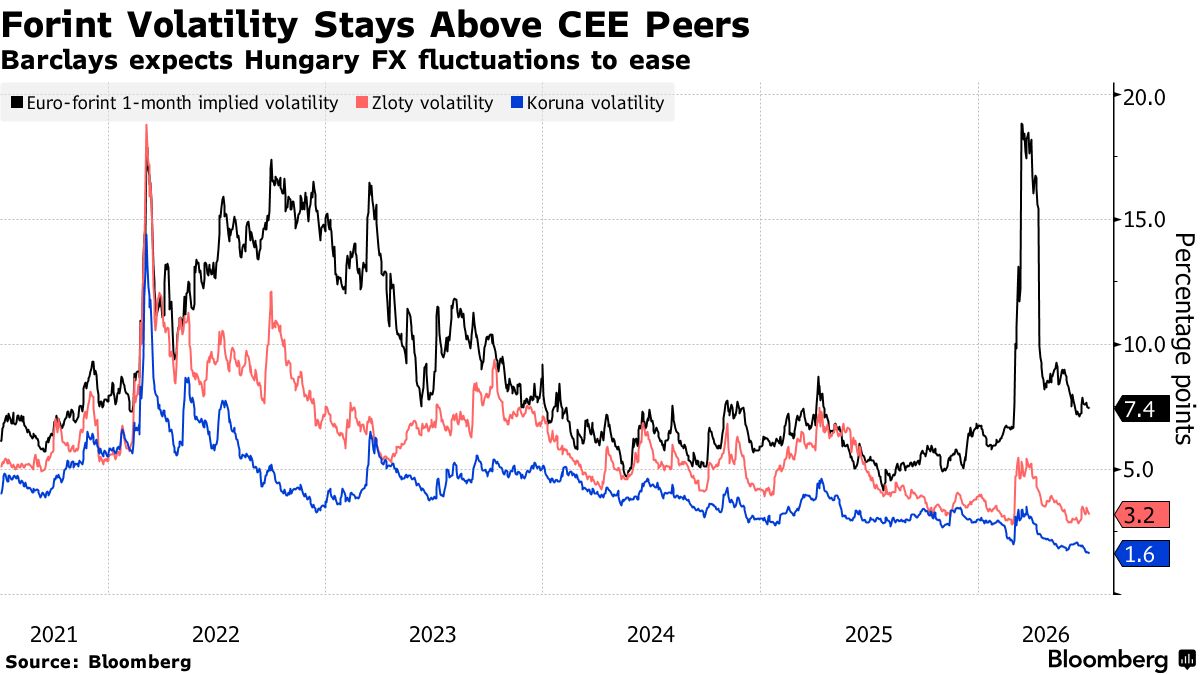
After the rally in the forint and bonds, Barclays now sees the next opportunity in trading the diminishing volatility itself.
“EURHUF volatility will continue to grind lower,” Raczko said. “The implied volatility is still substantially higher than what you see in EURPLN and definitely higher than what you see EURCZK. That’s where probably the opportunity is still.”