Goldman Sees ‘AI-Driven Super Surplus’ Swelling in Korea, Taiwan
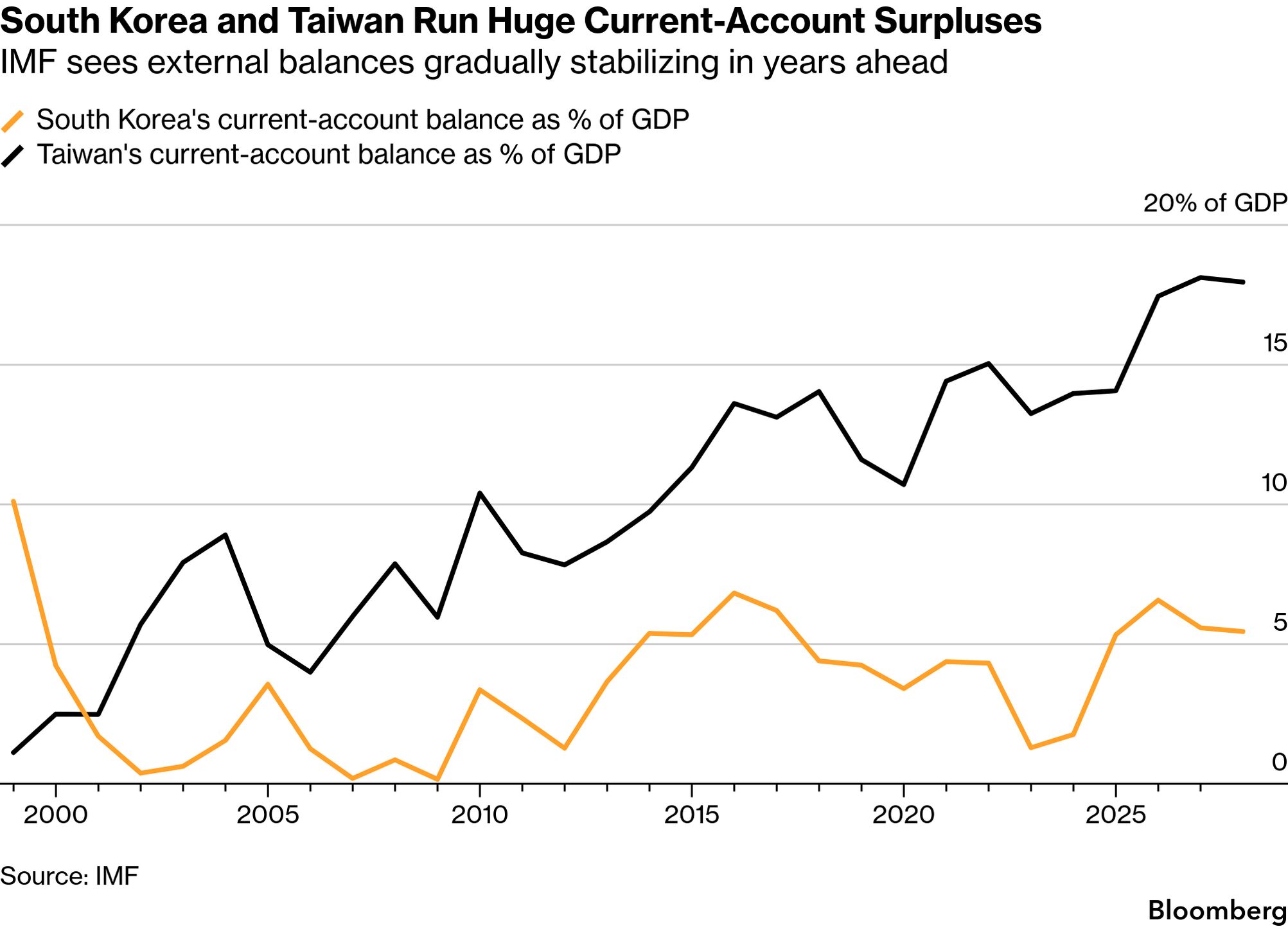
South Korea and Taiwan’s artificial intelligence-fueled chip booms are set to swell both economies’ current-account surpluses to fresh records and pressure their central banks to raise interest rates later this year.
That’s according to Goldman Sachs Group Inc. economists led by Andrew Tilton , who now expect two 25-basis point interest rate hikes in Korea in the third and fourth quarter, and two 12.5-basis point increases in Taiwan in the second and fourth quarters.
The analysts see the tech-export surge pushing what they call the “AI-driven super surplus” in current accounts above 10% of gross domestic product in Korea in 2026 and to over 20% of GDP in Taiwan. The trend will likely persist despite both economies’ reliance on energy imports from the Middle East, according to Goldman.
“This AI boom is the strongest tech cycle on record for Korea and Taiwan,” the economists said. “Even under our various adverse oil-price scenarios, the impact on chip-energy balances should be immaterial since the scale and growth of chip exports completely dominate the energy price path.”
Korea’s AI-related exports could triple to almost 30% of economic output this year — from less than 10% over the past decade — while Taiwan’s could rise further in excess of 30% of GDP, they wrote. Meantime, non-tech exports are likely to remain subdued amid regional oversupply and the energy shock confronting the region.
So far, Korea’s surplus has been recycled mainly into overseas equities and Taiwan’s into FX deposits, according to Goldman, but appreciation pressure may be building.
“The K-shaped cycle argues for targeted, prudent fiscal policy,” the economists wrote in the note dated May 11. “With the outsized AI-driven export boom, both currencies should face appreciation.”
Taiwan’s economy grew at its in the first quarter and have been on a tear, with shipments of semiconductors the primary driver. The boom is for policymakers as the two-speed nature of growth sees few workers vault ahead while the rest languish.
Still, bullish forecasts suggest there’s plenty of upside for both economies. A recent note from Chetan Ahya , chief Asia economist at Morgan Stanley in Hong Kong, said Asia is entering an that’s driven in part by the artificial intelligence boom and AI-related infrastructure.
The Goldman economists expect South Korea’s GDP growth to rebound to 2.5% this year, from 1% in 2025, and Taiwan’s to accelerate to almost 10% in 2026, from 8.7% last year. The tech boom may increase growth volatility, the Goldman economists said.