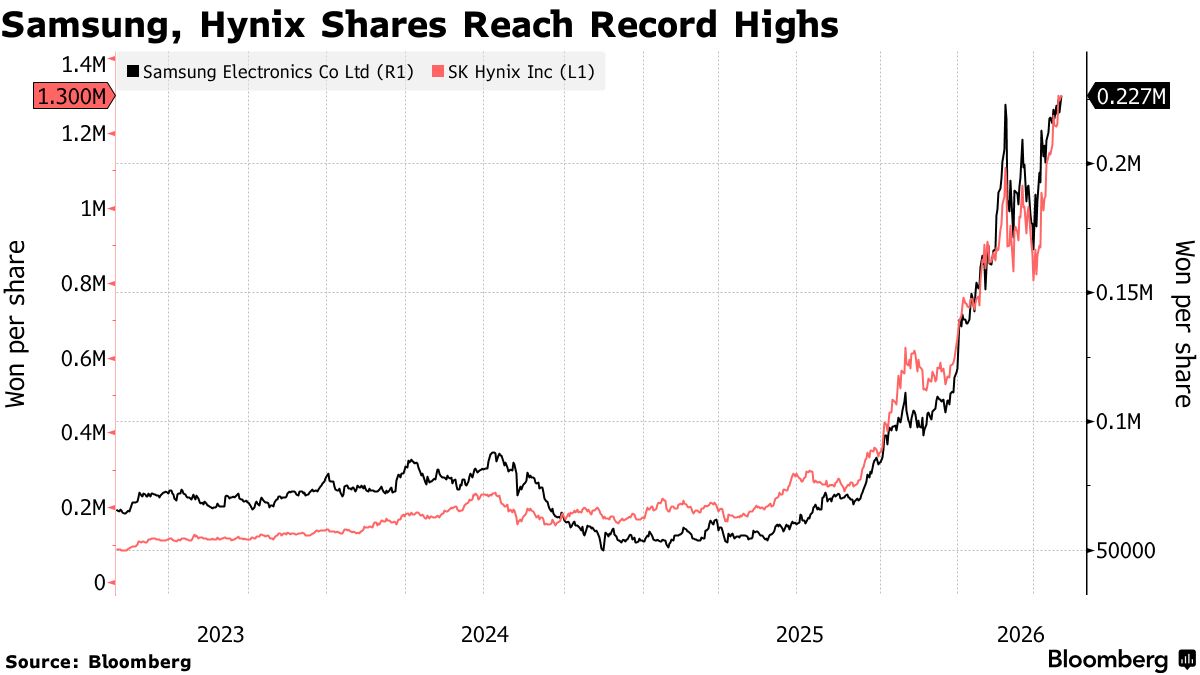
Samsung, SK Hynix Payouts to Fuel Rate Hikes, Mirae Asset Says
The extraordinary wealth generated from South Korean chipmakers will drive spending and inflation, spurring the nation’s central bank to raise interest rates at least three times over the coming year, according to Mirae Asset Global Investments.
Chipmakers’ employee bonuses and high chip prices, as well as booming stocks, are likely to keep prices elevated, and push the Bank of Korea’s policy rate to as high as 3.5% by the second half of 2027 from the current 2.5%, Choi Jinyoung , Mirae’s head of fixed-income and executive managing director, said Tuesday in an interview. Korea’s 10-year sovereign yield is likely to break at least above 4% in the next two months for the first time since 2023, he added.
posted an eight‑fold profit this month, far above expectations, underscoring strong demand for AI memory chips despite Middle East turmoil, while reported a five‑fold in quarterly profit.
“Employees of Samsung and SK Hynix receive these incentives, and where else are they going to spend that money?” said Choi, whose firm manages about 339 trillion won ($228.4 billion) of assets and is one of Korea’s largest asset managers. Choi manages about 9 trillion won of bonds at the firm.
Choi’s view highlights a more hawkish stance than many market watchers, shaped by the fast‑moving impact of AI on Korea’s economy. Added to that is the oil shock stemming from the Iran war, which is adding to inflation risks and may force the Bank of Korea to keep monetary policy tight.
Crude oil is unlikely to provide relief. Even if the Iran war ends, supply‑chain disruptions will keep oil prices elevated, Choi said.
Given current pricing dynamics, Choi maintains a bearish outlook on Korean debt, advising investors to avoid the “vulnerable” 5- to 10-year segment. Instead, he sees opportunities in short-dated corporate debt with maturities under two years, where some yields of over 4% have already priced in much of the BOK’s upcoming hiking cycle.
His hawkish outlook contrasts with JPMorgan Chase & Co.’s forecast for just one increase by mid-2027, Citigroup Inc.’s projection of at least two, and United Overseas Bank’s expectation of none this year.
The background of newly appointed Bank of Korea governor Shin Hyun Song may also shape policy, Choi said. With extensive experience in international finance and policy making, “Shin has long focused on currency volatility and is more likely than his predecessors to factor the won into rate decisions,” he said. Shin will hold his first monetary policy meeting on May 28.
Shin’s arrival comes just as the broader economy is heating up. First-quarter gross domestic product even the most bullish forecasts, and Choi said that will impact inflation. “Growth forecasts are being revised upward,” he said. While the Bank of Korea estimated GDP to grow around 2%, Choi said “over 3% growth is possible.”
Construction investment 2.8% during the quarter, a development Choi found particularly notable. “The industry has a huge impact on domestic demand,” he said.