Mounting Exporter Strain Risks Complicating China’s Yuan Policy
The yuan’s continued strength is exerting pressure on Chinese exporters on a scale rarely seen in recent years, complicating Beijing’s efforts to manage the pace of currency gains .
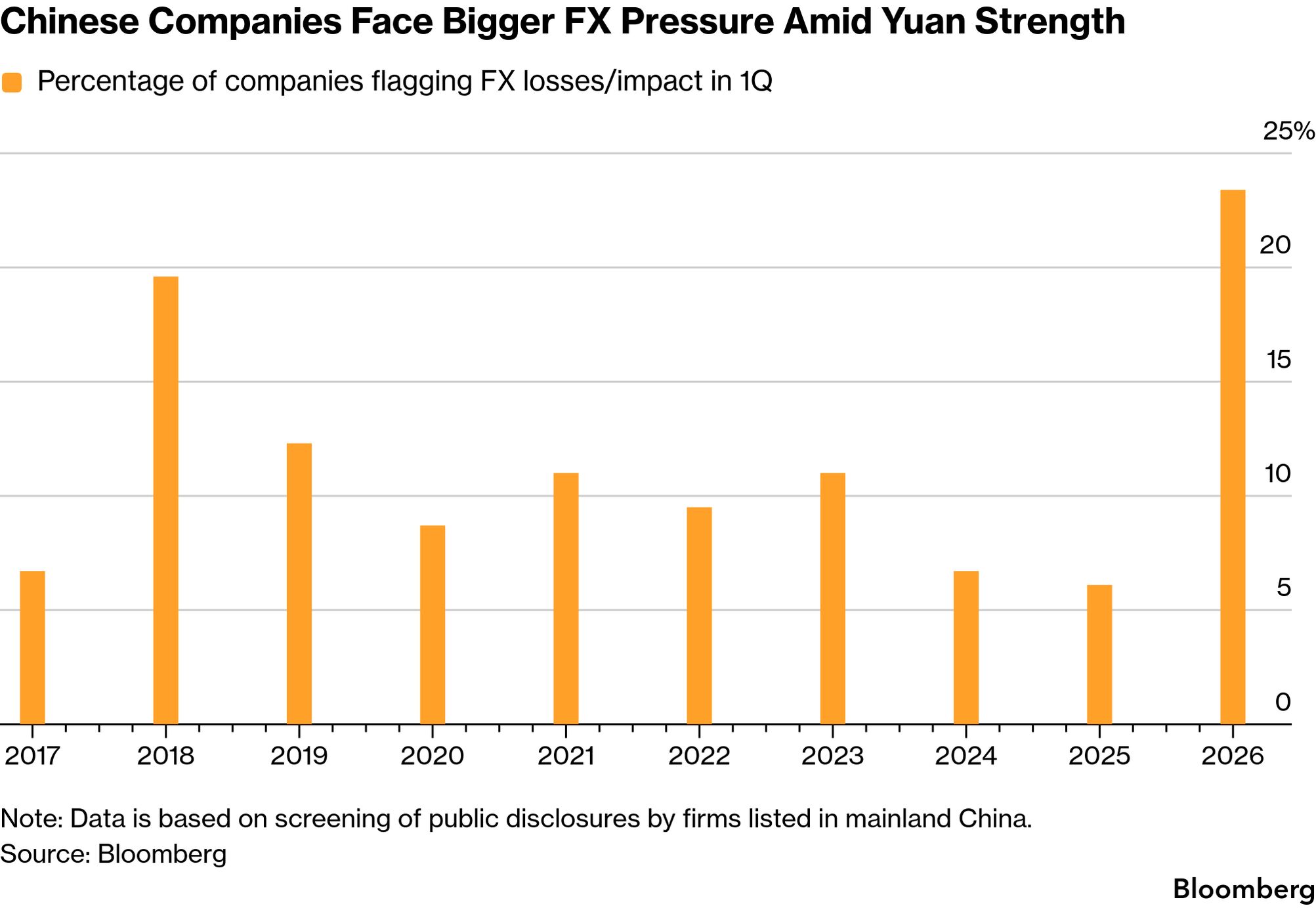
Almost a quarter of some 5,500 firms listed onshore flagged foreign-exchange losses or cited currency swings as a major driver of higher financial costs weighing on profits, according to data compiled by Bloomberg from first-quarter earnings reports. That share is the highest in at least a decade, and well above the roughly 10% average for the January-March period in the previous nine years.
The pressure is building after years in which exporters amassed large foreign-currency holdings amid China’s trade boom while keeping hedge ratios low. A — it has advanced in May after climbing in eight of the previous nine months — is eroding margins and raising the risk of FX losses for firms.
and JPMorgan Asset Management are among those expecting more yuan gains, signaling that pressure on exporters and corporate balance sheets may only intensify. That risks deepening a dilemma for policymakers trying to maintain currency stability without hurting a . For firms sitting on large dollar holdings , such expectations have created a vicious cycle.
As exporters convert their dollars into yuan, they end up strengthening the Chinese currency. Consequently, “the more they convert, the more they lose — and the more they lose, the more they feel compelled to convert,” said Zhang Zhiqing , founder of Beijing-based FX advisory firm Nalan Rongke Information Technology. He expects the pressure on companies to continue into the second quarter.
Exports remain a of China’s economy as domestic consumption . The nation received a record amount of foreign payments in April, official data show.
Read more:
Rising export revenues and a growing share of overseas income for listed companies are among the main reasons behind yuan appreciation leading to FX losses, Li Liuyang , chief analyst for foreign exchange research at China International Capital Corp., said in an interview.
From traditional manufacturers to technology firms, exporters are seeing margins squeezed as overseas revenues convert into fewer yuan. Industrial companies including and Xuzhou Construction Machinery Group Co. have flagged losses linked to the currency’s strength, with the latter saying in its first-quarter report that financial expenses rose nearly 747% year-on-year due to exchange-rate fluctuations.
BYD Co., one of the world’s largest electric-vehicle makers, reported about 2.1 billion yuan ($309 million) in financial charges for the quarter, mainly due to FX losses, compared with currency-linked gains recorded a year earlier.
The onshore yuan has risen about 6% against the dollar over the past 12 months, the second-best performance among Asian currencies. The central bank has had to walk a fine line between and allowing the currency to strengthen, in part to appease wary of the nation’s massive shipments.
The People’s Bank of China didn’t immediately respond to a fax requesting comment.
Authorities have already made yuan’s rise, said Fiona Lim , senior FX strategist at Malayan Banking Berhad, adding that slowing the pace of appreciation would give Chinese companies more time and flexibility to hedge.
Low corporate hedge ratios have also amplified the impact for exporters, leaving many of them more exposed to yuan gains, analysts said. The currency weakened for three straight years through 2024, reducing incentives for firms to hedge. At the same time, relative to China eroded the appeal of hedging strategies, with negative dollar-yuan forward points making it more costly to lock in future exchange rates.
In 2025, companies’ use of forwards and options for hedging remained around 20% on average on a monthly basis, marginally above levels seen in the previous two years, according to Bloomberg’s calculations based on official data. While the ratio climbed to nearly 26% in the first quarter, overall coverage against exchange-rate risks remains relatively low.
“Corporates probably underhedged the FX risk,” said Carie Li , a strategist at DBS Bank Hong Kong. Given its commitment to keeping the currency stable, “the PBOC may come in to smooth or slow down the yuan’s appreciation.”