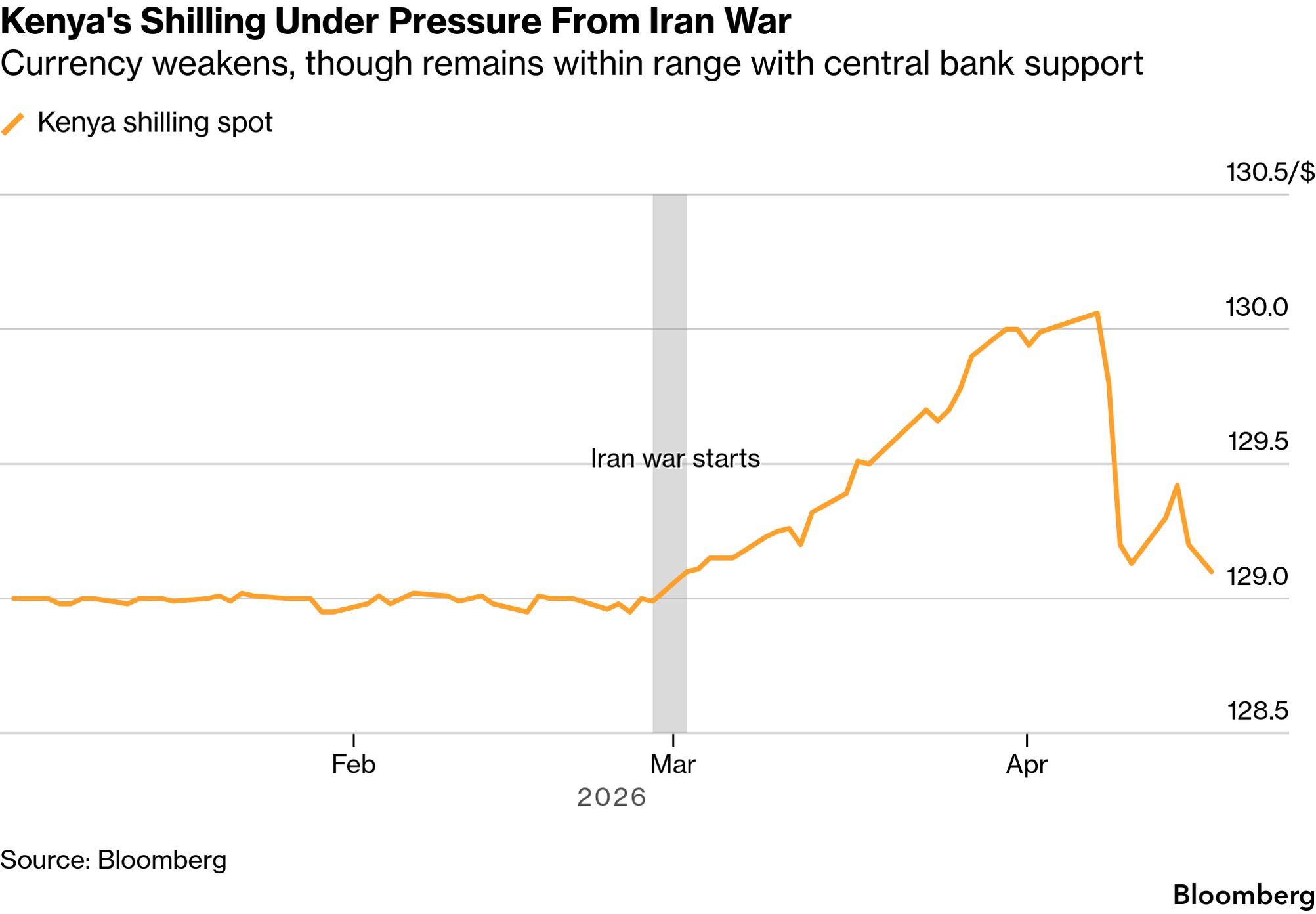
Wall Street Banks Flag Risks for Kenya’s Shilling as War Rages On
Kenya ’s shilling is among the most vulnerable currencies in Africa, according to strategists at major banks, who predict the central bank will dial back on selling dollars and allow the currency to weaken over the coming months.
Strategists at , and have flagged the shilling’s frailty as high oil prices increase balance-of-payments stress for the East African nation, which imports almost all its fuel. Standard Chartered, for instance, sees the central bank “accommodating moderate upward pressure” on the exchange rate and expects the shilling to weaken to 132 per dollar by year end, from around 129 now, according to Razia Khan , head of research for Africa and the Middle East.
The Central Bank of Kenya maintains it has the firepower to keep volatility at bay even as depreciation pressures mount. It has a $13.3 billion foreign-reserves war chest “ ,” according to Governor Kamau Thugge , even after spending almost $1 billion in five weeks after the war began. While the currency briefly weakened beyond 130 earlier this month, it has remained largely within the narrow range around 129 that it’s held for the past two years.
The higher oil bills are contributing to a wider current-account deficit, which the central bank projects at 3% of gross domestic product this year, revising its forecast up from 2.2%. Kenya’s tea and flower exports, a key revenue source, are taking a hit from the war. The conflict’s toll prompted authorities to approach the World Bank to provide emergency funds to help offset the impact.
Read More:
If oil moves back above $100 and stays there, the currency could slide to 135 shillings this year, a level last seen two years ago, should Kenyan authorities “let it move to that,” according to Citigroup’s chief Africa economist David Cowan . A heavy reliance on Middle Eastern oil imports and 10% of the nation’s remittance flows originating in the Gulf will pile pressure on the unit, he said.
On Monday, market jitters returned as a turbulent weekend in the Middle East cast doubt on the prospects for peace talks or the extension of two-week long ceasefire. Brent futures rose 6%, and the dollar gained against major peers.
Like most emerging and frontier markets, Kenya hasn’t been shielded from the selloff over the 53 days of the conflict. The Nairobi Securities Exchange saw outflows for a fifth consecutive quarter in the three months through March. Net foreign outflows accelerated after the war started in Iran and more than doubled from the previous quarter, according to Nairobi-based Pergamon Investment Bank.
A “large scale” exit by non-residents will stoke shilling weakness, according to Gergely Urmossy , senior frontier-markets strategist at Societe Generale.
“I do think that shilling valuations and an FX adjustment will be a hot topic in the second half of this year as the current-account widens,” he said.