Why South Korea’s Won Is Weak Despite An AI-Driven Stock Boom
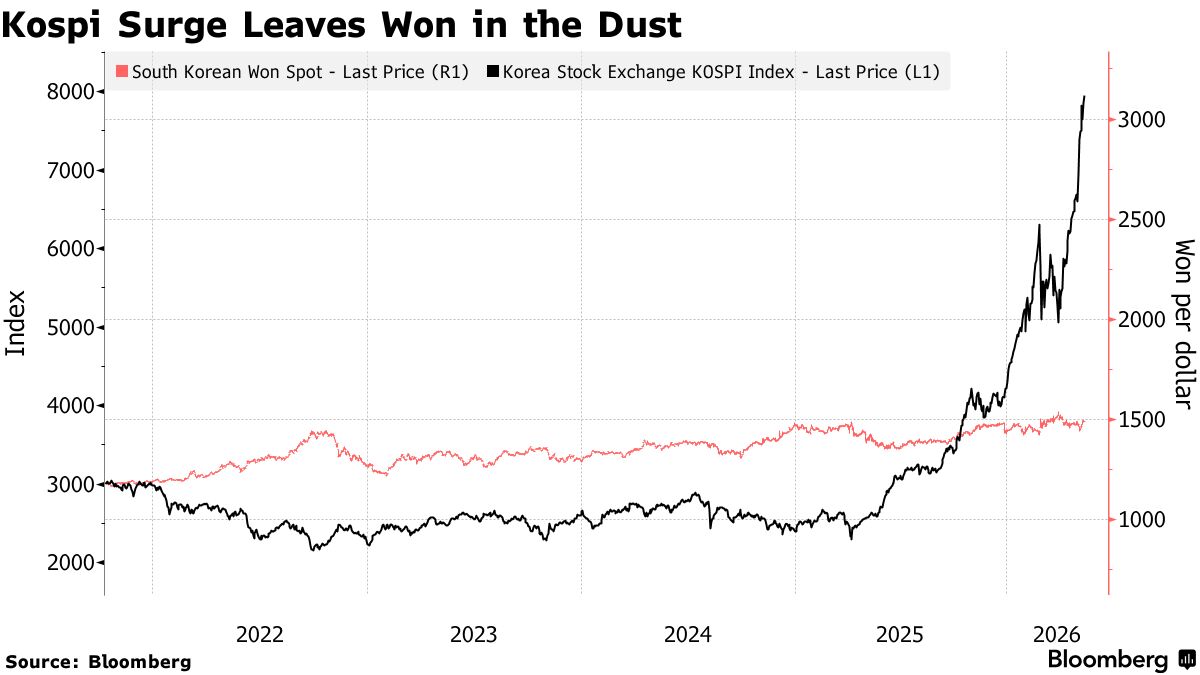
A global AI boom has turbocharged demand for chips from South Korea’s tech giants, including and , helping to drive the country’s benchmark Kospi stock index up more than 150% over the past year. Yet despite the Kospi outpacing every other major equity market in the world, the South Korean won remains one of Asia’s weakest currencies.
That disconnect is unusual. Strong stock-market gains are typically accompanied by a strengthening currency, especially in export-driven economies like South Korea. Here’s what to know.
What’s happening to the won?
The South Korean won has been declining since mid-2025, but it breached the psychologically important 1,500 per dollar level in late March — the weakest level since the 2009 global financial crisis. The decline was driven by escalating geopolitical tensions tied to the US-Iran war, as well as capital outflows from the local stock market as foreign investors sold securities in favor of safer assets.
The currency later recovered some of its losses, but drifted back toward its March lows in mid-May as rising tensions in the Middle East pushed oil prices above $100 per barrel. That matters because South Korea imports almost all of its energy needs, meaning higher oil prices increase demand for US dollars to pay for those imports, putting additional pressure on the won.
The won has been one of Asia’s worst-performing currency so far this year. It’s about 4% weaker than at the start of 2026 — even as South Korea’s benchmark Kospi stock index climbed above 8,000 points for the first time.
What’s the traditional correlation between the stock market and the won?
Historically, the value of the won has risen in tandem with the stock market. That’s because foreign investors have long played a major role in South Korean markets, and buying Korean equities typically requires them to convert foreign currency into won, increasing demand for the local currency and pushing up its value.
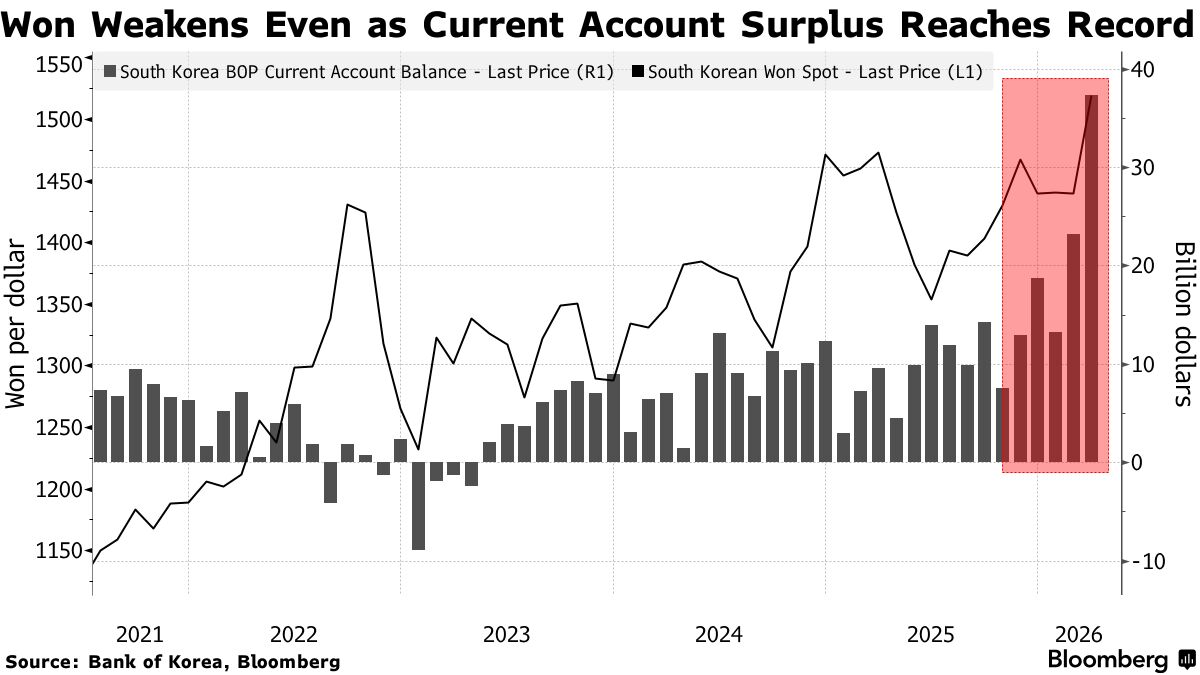
South Korea’s export-driven economy has reinforced that relationship. During periods of strong exports and large current account surpluses — meaning the country has earned more from exports and overseas income than it spent on imports and foreign payments — exporters such as Samsung Electronics would convert larger amounts of overseas earnings into won, increasing demand for the currency.
Strong exports also tended to increase the appeal of Korean assets to global investors, attracting additional inflows into local stocks and bonds and reinforcing the cycle.
Why has the relationship between the Kospi and won changed?
The Bank of Korea says the composition of the country’s overseas assets accumulated through current-account surpluses has shifted over time. In the past, much of the surplus was channeled into the central bank’s foreign-exchange reserves. Now, a growing share is flowing into private-sector portfolio investments. This shift has also coincided with Korea’s rapidly aging population, with households and institutional investors looking overseas for higher returns on their savings.
As those investment flows have grown, they have become more influential in determining the won’s value than trade flows such as exports and imports. The BOK says the relationship between Korea’s current-account surplus and won strength began to weaken around 2015.
The structure of Korea’s stock market has also changed. Local investors are now increasingly to absorb shares sold by foreigners, helping to sustain the stock-market rally without generating the same overseas demand for the won.
The won is also facing pressures of its own. Rising oil prices triggered by the US and Israel’s war with Iran have weighed on the currency because they increase South Korea’s import bill, adding further downward pressure on the won. At the same time, the geopolitical tensions stemming from the war have dampened global risk appetite, hurting the won because the currency is widely seen as gauge of sentiment toward global trade and economic growth.
Adding to those concerns, in the US as part of a broader trade agreement with Washington has fueled speculation that the plan could place additional pressure on the won because it would require large amounts of the currency to be sold in exchange for US dollars to fund the investments.
Is South Korea worried about the weak won?
Yes, and the concern is not new. In December, the government introduced a series of measures to encourage capital to stay onshore. These included tax benefits on overseas equity sales when proceeds were reinvested domestically, and an increase in the tax-exempt portion of dividends from overseas subsidiaries to 100% from 95%.
Authorities have also stepped up verbal intervention in order to prevent speculative currency trading. Verbal warnings from the finance ministry and central bank — often interpreted by traders as a precursor to actual intervention — increased at the end of last year, signaling concern about excessive currency volatility. Data from the central bank also showed that South Korea’s FX authorities a net $22.5 billion in the market to defend the won in the fourth quarter of 2025.
Government efforts to tame the won’s weakness have proved short-lived. While the won pared some of its losses earlier this year, it weakened again after the Iran war broke out.
A move announced in April by the National Pension Service, South Korea’s largest pension fund, its cap on currency hedging is expected to support the won by increasing demand for the local currency. Meanwhile, talks over a possible currency swap deal between South Korea and the US have resurfaced as policymakers search for a more durable solution.