Yen Slips as BOJ’s Ueda Fails to Give Clear Rate-Hike Signal
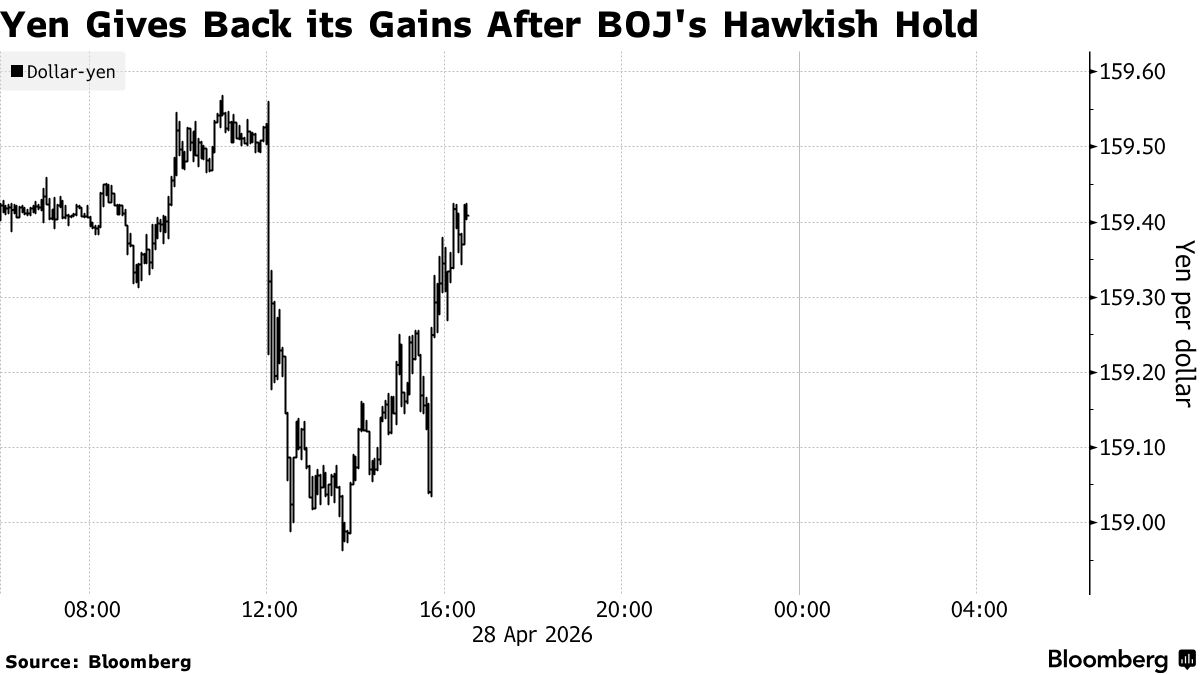
The yen turned lower against the dollar after Governor Kazuo Ueda refrained from giving a decisive signal about the timing of an interest-rate hike following the Bank of Japan’s to leave policy unchanged.
Japan’s currency fell as much as 0.2% to 159.69 against the greenback. It earlier strengthened as far as 158.96 as the number of BOJ board members in favor of a rate hike increased to three, compared with one at its March meeting.
The upside risks to prices in Japan are greater than the downside risks to the economy for the current fiscal year, Ueda said in a press conference, while adding that he wants to assess the impact of the Middle East conflict further. Japan’s central bank raised its forecast for core inflation to 2.8% for this fiscal year and revised down its economic growth forecast to 0.5%.
“Governor Ueda’s stance is not particularly hawkish,” said Hirofumi Suzuki , chief FX strategist at Sumitomo Mitsui Banking Corp. “While acknowledging the possibility of a rate hike at the June meeting or subsequent meetings, he appears to be emphasizing that any decision to raise rates will depend on the circumstances at the time,” he said. “This is likely to be seen as depreciation pressure on the yen.”
Even so, the outcome of the April policy meeting highlighted a growing hawkish tilt within the board, and underscored how uncertainty over the war in Iran and the resulting surge in energy prices are clouding the economic outlook and becoming a bigger concern for the BOJ as it balances inflation risks against growth.
Short-end government bond yields rose and the exporter-heavy Nikkei 225 fell 1%.
Read more:
“The BOJ’s hawkish hold today — marked by a rise in dissents to three out of nine board members — should be seen as much about currency defense as inflation control, signaling growing intolerance for further yen weakness,” said Masahiko Loo , a senior fixed-income strategist at State Street Investment Management.
The chance of a rate hike by June increased to 66%, from about 62% before the BOJ decision, according to overnight index swaps . A 25-basis-point increase is now almost fully priced in by July.
Protracted US-Iran tensions have kept investors on edge and reduced expectations for near-term BOJ . Tehran’s of an interim deal to reopen the key shipping passage has done little to dispel uncertainty following stalled .
The backdrop has supported the dollar and kept oil prices elevated, stoking inflation in Japan while raising downside risks to growth.
Japan’s Minister of Finance Satsuki Katayama on Tuesday said authorities are standing by to respond to forex moves as needed around the clock, as Tokyo remains on high alert over speculative moves that are weighing on the currency.