Australian Pensions to Lift Currency Hedging as Iran War Lingers
The vast majority of Australia’s pension funds intend to shield their portfolios from currency swings amid fears tensions in the Middle East will rapidly escalate, according to a survey by .
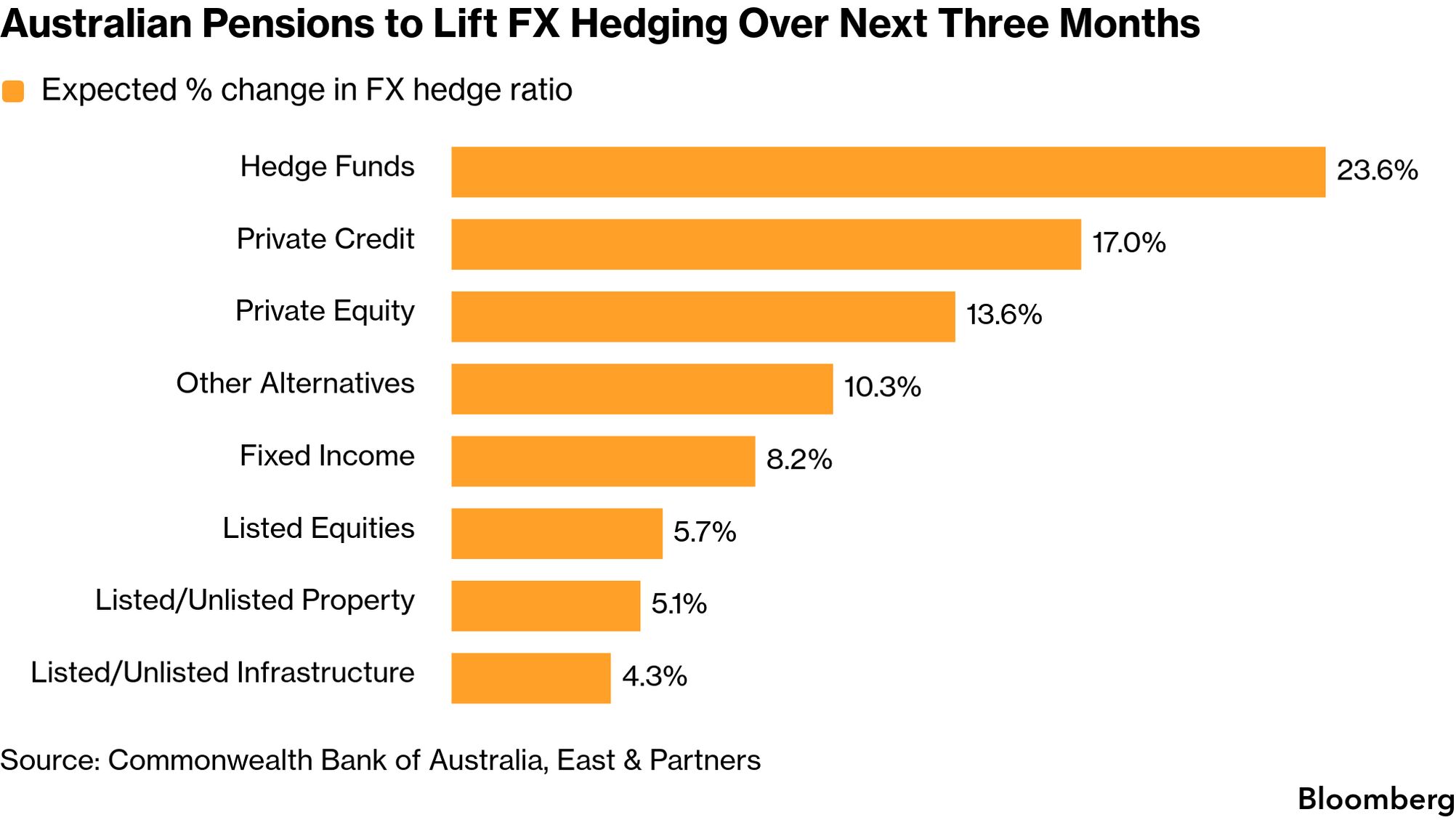
Nearly 90% of funds plan to increase hedging ratios across asset classes over the next three months, with a particular focus on hedge funds, private credit and private equity, the survey showed. None intend to reduce their currency hedging, it found.
The report comes as traders grapple with uncertainty surrounding the Iran conflict, with any escalation likely to trigger fresh volatility in currency markets. That poses a growing risk for Australia’s pension funds, which have more than half of their holdings invested offshore, mainly in the US, leaving them particularly exposed to swings in the Australian dollar.
With tensions unlikely to ease soon, the conflict may escalate in the coming months as Trump seeks leverage to get an acceptable deal in peace negotiations, said Joseph Capurso , who co-authored the report.
“There’s a high risk that it’s going to get a lot more volatile. The US, at the moment at least, has got a pretty weak hand,” Capurso, who’s head of FX, international and geoeconomics research, said by phone. “If you’re worried then you hedge and lock in some gains or protect yourself from downside.”
Currency markets tend to react quickly to geopolitical shocks, with the Australian dollar often seen as a proxy for global risk appetite. During the crisis, the Aussie slumped as much as 4% by end-March before rebounding on hopes of a US-Iran truce.
While Australia’s pension funds had already begun lifting hedge ratios before the conflict, more than three-quarters of equity portfolios remained unhedged, according to government data. Funds typically expect the Aussie to weaken during bouts of volatility, helping cushion broader portfolio losses.
Still, the currency has risen more than 7% against the dollar this year, making it the second-best performer among Group-of-10 peers and extending last year’s almost 8% gain. More than three-quarters of pension funds said a 10% rise in the Aussie would hurt returns, with average losses estimated at 7.8%, the survey found.
Pension funds are not only “worried about what the Aussie might do, but also what might happen to their asset prices as well, given we’re in this very uncertain time,” said Capurso.