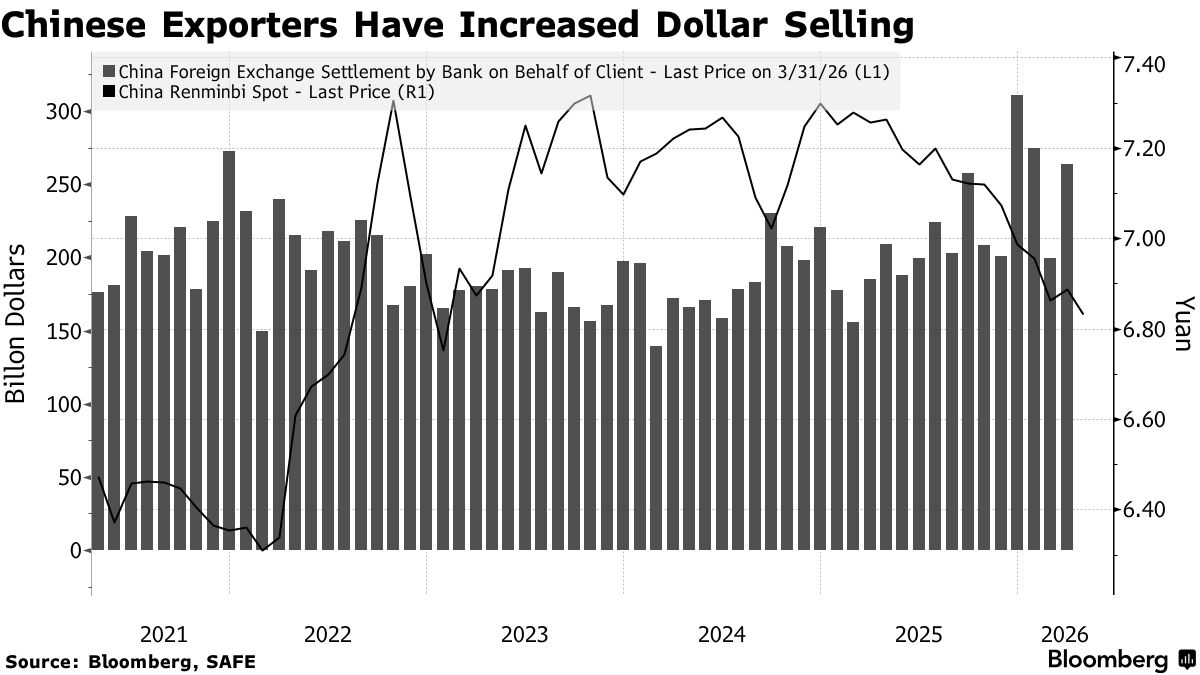
China Exporters Beset by Yuan Surge Look to Sell Dollar Rallies
Gloria Yu’s company exports bicycles and related accessories to as far as Europe and Africa. Having suffered “heavy losses” on some orders due to the yuan’s rapid gains earlier in the year, Yu is looking to better manage her dollar exposure.
“My heart was bleeding,” Yu said at the , the world’s largest trade show that started last week in China’s southern metropolis of Guangzhou. Interviews at the fair with more than a dozen firms that sell goods from electrical equipment to smart wearables show that exporters are increasingly positioning to sell the dollar on any rally, as they expect the yuan further this year.
China’s markets have largely shrugged off the war in the Middle East, in part due to the to the energy shock triggered by conflict. While the yuan weakened against the dollar alongside global currencies in March, it is back to trading at the highest level since early 2023.
“With the exchange rate hovering around 6.83, we will choose to convert dollars into yuan as soon as the rate approaches 6.9,” said Lawrence Law, a sales manager from Jiangsu province in East China, whose company exports refrigeration equipment and copper tubing.
The yuan’s near one-way rally since mid-2025 means the central bank has had to walk a fine line between and allowing the currency to strengthen, in part to appease wary of the nation’s massive shipments. It rose for seven straight months through February against the dollar — the longest run since early 2021 — helped by factors such as improving US-China relations and broad weakness in the greenback.
While a rising currency has a negative impact on exporters’ profit margins, quick appreciation is particularly tough for small exporters who lack the resources to hedge currency risks and absorb margin swings.
Yu from China’s Anhui province cited one example from earlier in the year: she accepted an order that was priced at 7.0 yuan per dollar, only to see the rate move to 6.83 by the time she received the payment. Later, as the Middle East conflict pushed the rate back above 6.9, she quickly converted the proceeds to help limit the damage.
She said she expects the yuan to “probably” appreciate to around 6.7 this year.
Meanwhile, companies are also using other ways to cushion the impact of the rising yuan, including renegotiating contracts to reflect currency movements in pricing.
“If the yuan continues to strengthen, our dollar-denominated quotes will be higher,” said Law from Jiangsu.
Higher US interest rates relative to China are also shaping exporters’ conversion decisions, with dollar-yuan forward points remaining negative for the past three years. That makes it less attractive to lock in future rates, reinforcing the preference to sell into spot market rallies.
A foreign-exchange business manager at a state-owned bank said more clients were placing their FX selling orders at nights in March as overnight created better opportunities to sell the dollar at higher levels. The rate was mostly 50-100 pips better than the onshore closing level, occasionally widening to as much as 200 pips.
“The bias among exporters is for USD/CNY to head lower, more due to broad dollar weakness,” said Alex Loo , a strategist at TD Securities in Singapore. “That’s evident among the above-average FX net settlement ratio we have seen in the previous months,” he said, signaling faster conversion of dollar receipts into yuan.