China Moves to Slow Yuan Rally by Cooling Fixing Volatility
China’s central bank is using its daily reference rate to temper the yuan’s rally as the currency’s outperformance during the Iran war fuels further bullish sentiment.
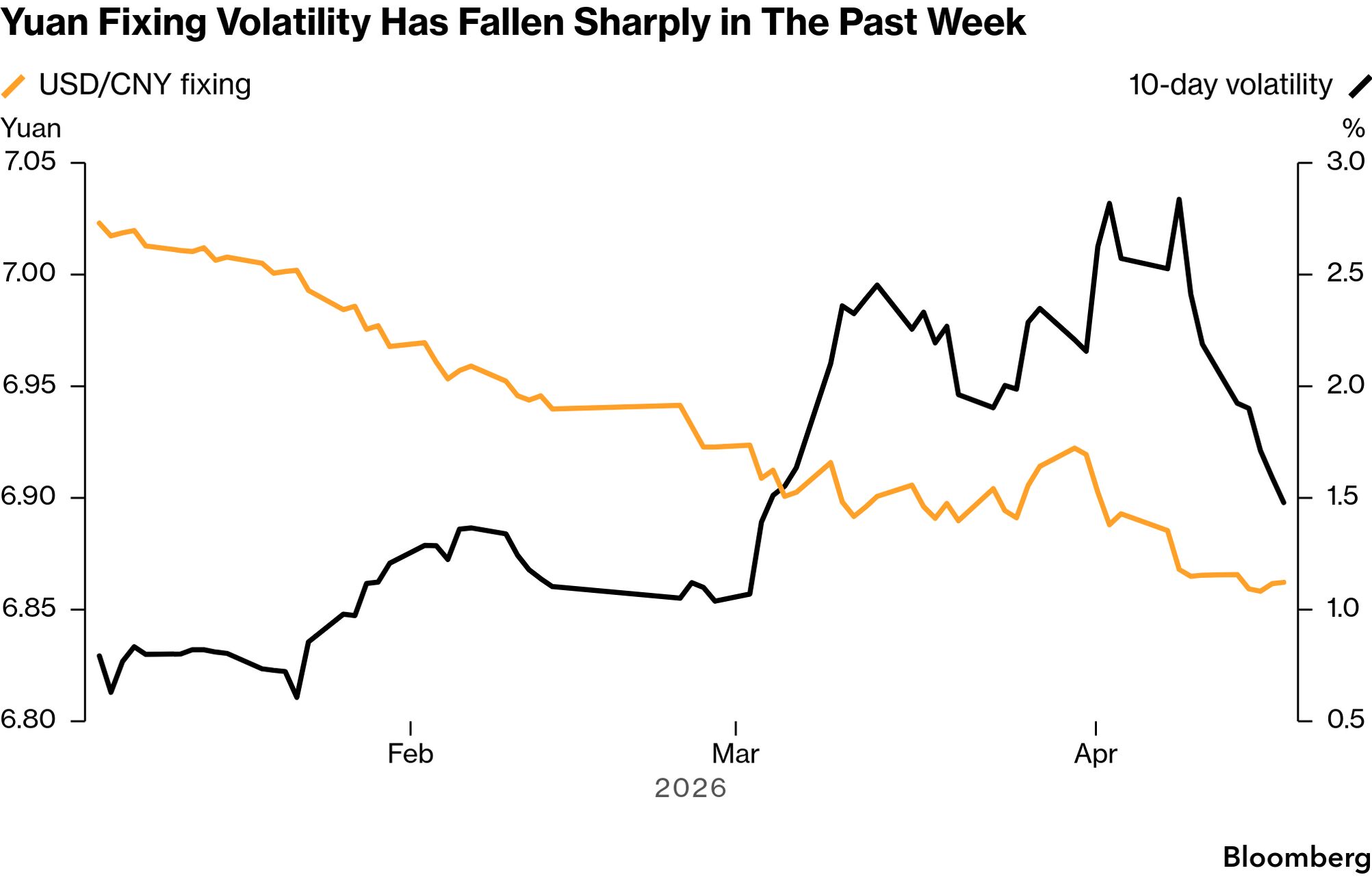
The 10-day volatility of the yuan’s daily reference rate set by the People’s Bank of China declined sharply this week before touching the lowest level since early March, according to data compiled by Bloomberg.
Decreased volatility in the daily fixing — the midpoint that limits the yuan’s onshore moves to a 2% band — signals that China is discouraging fluctuations for the currency.
The move follows the yuan’s emergence as the sole gainer in Asia during the Middle East conflict thanks to China’s resilience to energy shocks. By anchoring the so-called fixing, the PBOC is pushing back against one-way bets on the yuan that threaten to blunt China’s export edge and derail the manufacturing recovery.
“The PBOC’s stance has turned neutral on the fixing management,” said Kiyong Seong , macro strategist at Societe Generale’s Hong Kong branch. “It has been successful to insulate the yuan from the global FX gyrations due to the war. But always, too fast yuan appreciation is not desired by them.”
Reflecting this cautious stance, the PBOC set the yuan fixing at 6.8622 per dollar on Friday, weakening it for a second straight session. The currency traded around 6.82, near a three-year high.
Global investors are increasingly viewing China as a safe haven during the Middle East conflict. Bilal Hafeez , head of market strategy at Macro Hive Ltd., said buying the yuan is “one of my favorite calls right now,” forecasting the currency to reach 6.4 versus the greenback by year-end.
However, the PBOC is building up defenses against any runaway gains in the yuan. Earlier this week, it raised the cap on offshore loans for some banks, a move that’s expected to ease the appreciation pressure on the currency.
Beyond policy signals, dollar purchases by Chinese state banks in recent sessions have helped blunt the yuan’s momentum. for foreign currencies from local firms last month may provide an additional headwind for the currency.
“I expect the PBOC to set the fixing slightly weaker than the consensus going forward,” Seong said.
The trajectory of the currency now hinges on the broader economic climate. However, the PBOC’s focus has shifted toward managing the pace of its advance given that the currency is widely seen as
This approach aligns with the views of Wee Khoon Chong , BNY’s senior APAC market strategist, who said the PBOC’s aim has been to smooth out market volatility without drawing a line in the sand.
“Dollar-yuan will go through 6.8 and beyond,” Chong said, adding that “There is a bias in the market that the yuan rally is always too fast and too strong.”