Korea’s Pension Fund NPS Expands Currency Hedging to Bolster Won
South Korea’s National Pension Service , one of the world’s largest pension funds, is revising its rules to permit greater foreign‑exchange hedging as it seeks to ease pressure on the won.
The $1 trillion fund will scrap a long-standing 15% cap on forex hedging, aiming for greater flexibility during periods of market volatility, according to a Tuesday statement from the Ministry of Health and Welfare, which oversees the NPS. The 15% level will instead serve as a baseline ratio, with room to adjust up or down as needed.
The fund also plans to adopt a currency-neutral performance framework, letting it manage exchange-rate risks without those moves weighing on official returns. Its statement also confirmed plans to potentially issue foreign currency bonds.
The move signals South Korea is opening the door for its massive pension fund to play a more aggressive role in markets amid won weakness. That shift may prove pivotal as Seoul prepares the first tranche of its $350 billion into the US under last year’s trade deal with Washington, an outflow widely expected to add pressure on the local currency.
“What was discussed today is that the FX hedge ratio will be set at a baseline of 15%, and execution will be carried out flexibly and elastically in consideration of market conditions,” said Lee Hyoung Ryoul, director general for international finance at the finance ministry. “Previously, FX hedging by the NPS had been applied only in exceptional circumstances, but this marks a turning point toward making it a core policy in overseas investment.”
The won advanced further after the announcement, rising as much as 0.7% to 1,471.30 per dollar.
Of the now-scrapped 15% cap, 10 percentage points had been allocated to strategic hedging, while the remaining 5 percentage points were reserved for tactical moves, according to the NPS’s .
The new baseline means the hedging limit has been expanded by five percentage points compared with before, Lee said. “Considering the actual scale of the pension fund’s hedging, this would result in an effective increase in hedging of about five to ten percentage points,” he added.
Heavy demand for dollars from South Korean retail investors buying US stocks and the NPS’s overseas investments — is driving the won lower, to levels that officials find increasingly uncomfortable. With hedging strategies, the NPS can help steady the won — for instance, by using FX forwards to sell dollars while locking in the current won value of its foreign assets to meet future pension obligations.
Read more:
In late 2022, the NPS initiated foreign-exchange hedging on a temporary basis, with the 15% cap, to help steady the won. The fund revamped the strategy last December to take a more , as the currency came under pressure from portfolio outflows.
New Framework
The cap change is part of South Korean authorities’ push for a “ ” to govern NPS’s activities, aimed in part at curbing the fund’s outsized impact on the foreign‑exchange market from its heavy demand for dollars.
To curb won volatility, South Korean authorities sold a net $22.5 billion in the fourth quarter last year. Even so, the won has declined about 2.6% against the dollar so far this year — the worst performer in Asia after the Indian rupee.
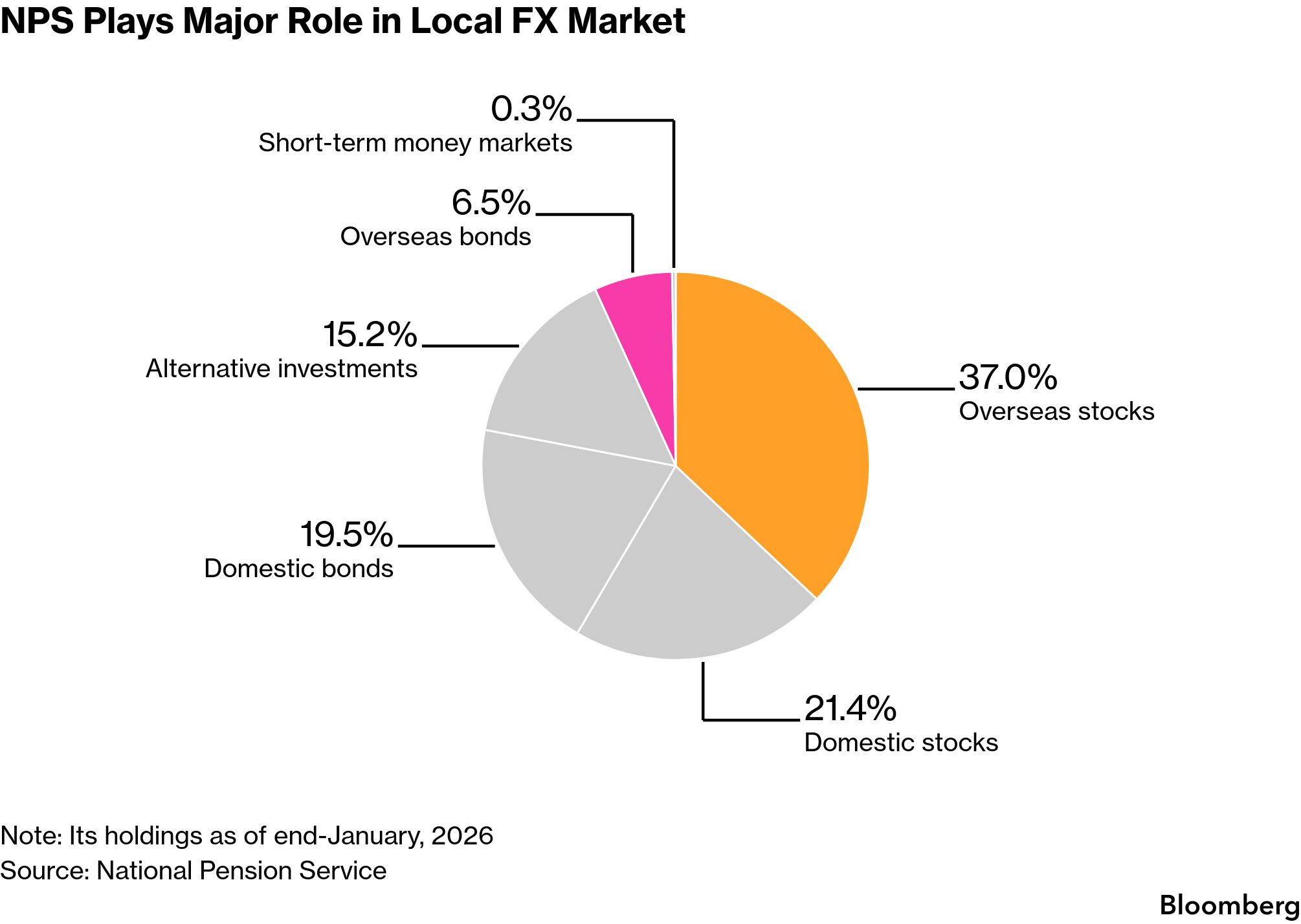
In January, the fund its target exposure to overseas stocks, following its of a swap agreement with the Bank of Korea. As of end‑2025, NPS held about $603.2 billion in foreign‑exchange assets, according to a March . Of that, $13.2 billion was tactically hedged, while the size of its strategic hedge was not disclosed.