Emerging-Market Assets Slip After Trump’s Ultimatum to Iran
Emerging-market assets declined as President Donald Trump’s ultimatum to Iran raised the risk of further disruptions to Middle East energy supplies.
The MSCI Emerging Markets Index fell 2.5% in early trading Monday, dragged down by a selloff in South Korean chipmakers. A gauge tracking developing-nation currencies dropped 0.3%, with the Philippine peso heading for a .
Risk assets remain under pressure as the Iran war enters its fourth week with little sign of easing. Trump gave Tehran the Strait of Hormuz or face strikes on its power plants, with the deadline expiring Monday evening in New York. Iran warned it would shut the waterway indefinitely and target US and Israeli energy infrastructure if attacked.
Separately, Israeli forces said they had begun wide-scale strikes on Tehran infrastructure.
“Our view is it is time for caution, not panic,” Martin Schulz , head of international equities at Federated Hermes, said on Bloomberg TV. “Duration is the main issue. The longer this drags out, obviously the worse it gets.”
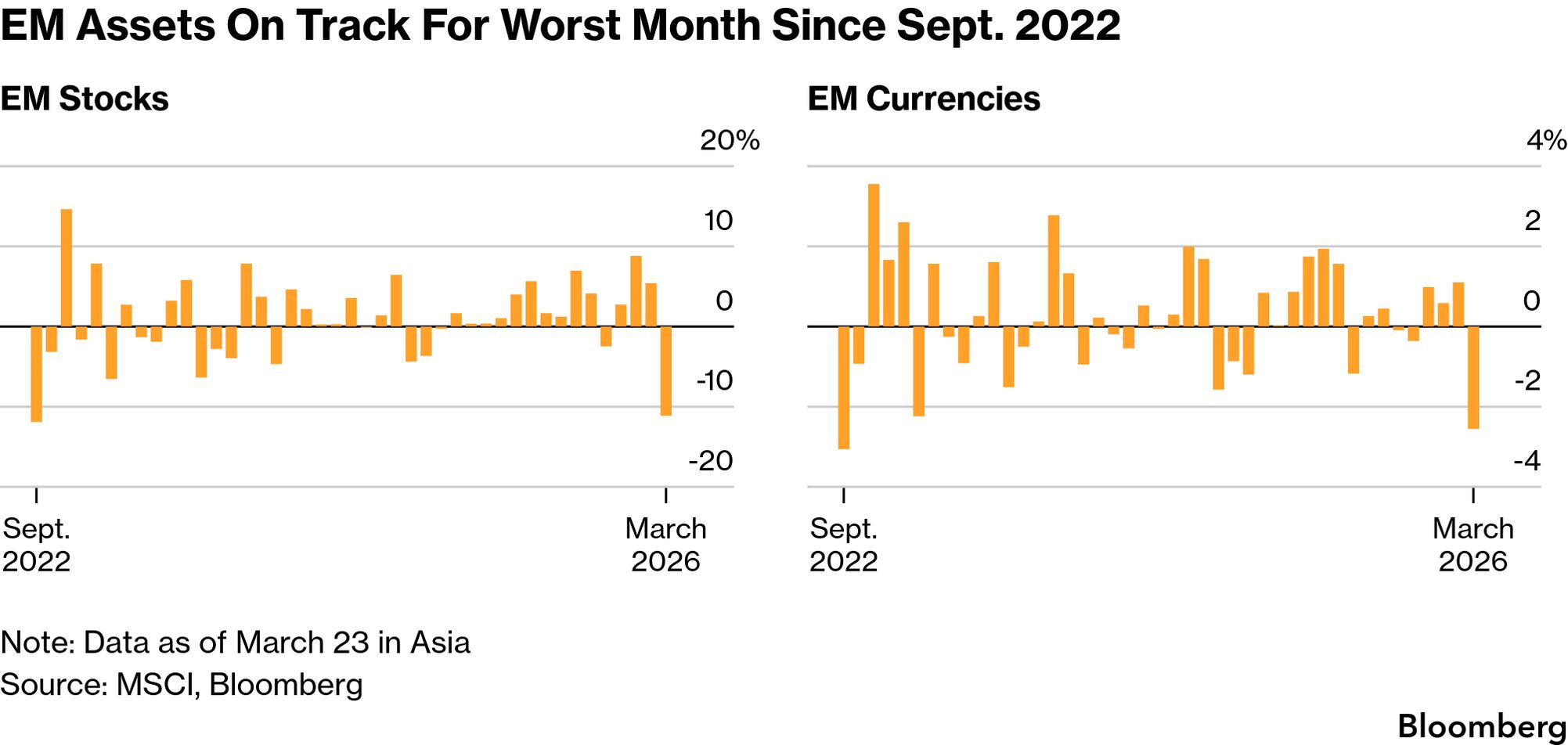
Oil traded at around $112 a barrel, stoking worries that high energy prices and strained supply lines will hurt global growth. The MSCI EM stocks index is on track for a more than 11% drop this month — its worst since September 2022 — while the gauge of currencies has fallen 2.6%, also set for the biggest decline since then.
South Korean stocks led declines in Asia, with the benchmark Kospi tumbling as much as 6.4%. A slump in futures briefly triggered a halt in program trading by the exchange. and were among the hardest hit as AI optimism faded amid concerns about higher interest rates.
The Korean won slid to its weakest level against the dollar since 2009 despite the of Shin Hyun Song — a senior Bank for International Settlements official seen as a hawk — as the next central bank governor. The Chinese yuan dipped after the central bank weakened its fixing by the most since November 2024, while the Philippine peso traded below 60 per dollar, adding pressure on authorities to stem losses.
“Extreme market volatility and geopolitical uncertainty remain the primary drivers of Asia-Pacific risk,” Wee Khoon Chong , a senior strategist at BNY wrote in a note. “Central banks and governments are expected to shift further into defensive mode: intensifying FX intervention to smooth volatility and deploying macroprudential measures to cushion living costs.”