PBOC Vows to Support Yuan Stability as Global Volatility Rises
China’s central bank governor reiterated a pledge to keep the yuan stable and vowed to insulate the nation’s financial markets from volatility spurred by the war in the Middle East.
“We will continue to keep the yuan basically stable and strengthen guidance for foreign exchange market expectations,” Pan Gongsheng , the Governor of the People’s Bank of China, said at a press briefing during the National People’s Congress on Friday.
The US-Israel strike on Iran has triggered risk aversion in international markets and has led to large fluctuations in the dollar index and other currencies, Pan said at the briefing. He noted that policy uncertainty among major economies and external volatility could spill over into China, adding that the PBOC will strive to insulate the domestic market from contagion.
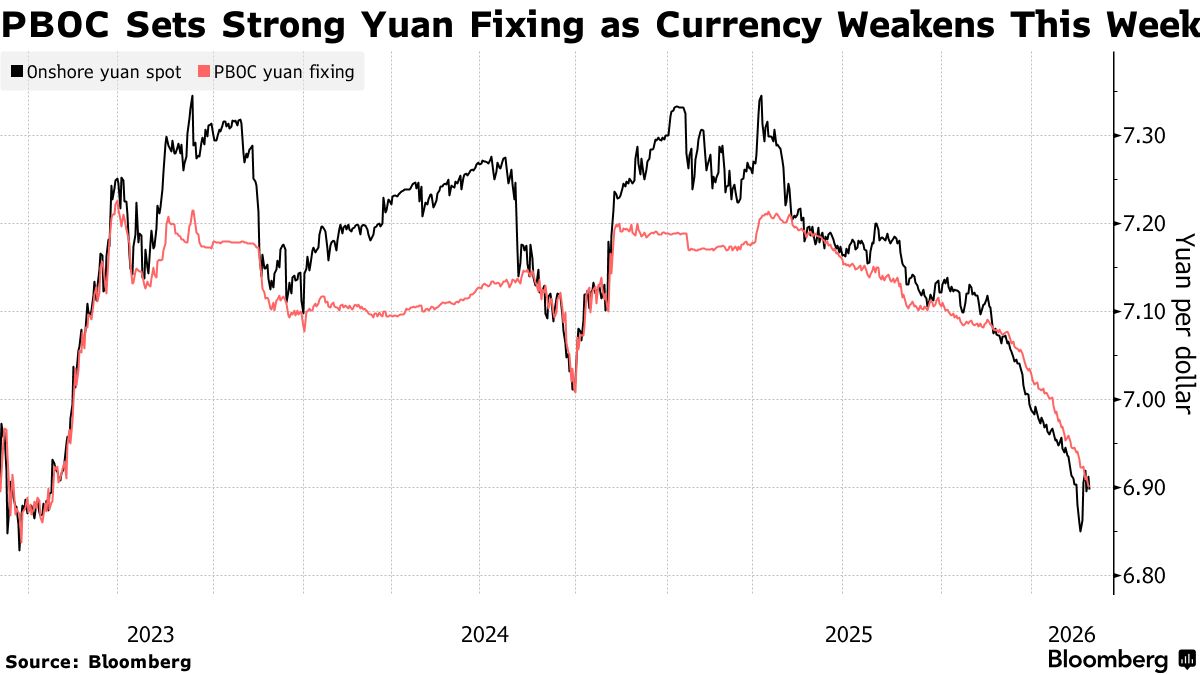
The PBOC has sought to steady investor nerves in the forex market this week by strengthening the yuan’s daily reference rate. This marks an abrupt reversal from its move just days earlier to slow the currency’s gains, as it now seeks to limit the fallout from escalating tensions in the Middle East.
The yuan’s exchange rate has remained within a “medium range” in recent years, Pan said. Its rise this year is backed by dollar weakness, economic fundamentals and foreign-exchange conversion by corporates, he said.
Meanwhile, Pan expects increased corporate use of foreign exchange hedging and yuan-denominated settlements to provide a buffer for Chinese trade. Approximately 60% of China’s imports and exports are now less susceptible to exchange rate fluctuations thanks to these tools, Pan said, adding that this figure is expected to rise further this year.
He reiterated that China will not seek to gain an edge in trade by depreciating the yuan.
Pan also said that, under certain circumstances, the PBOC will follow international rules and employ macroprudential tools to correct ‘herd behavior’ in the forex market. This follows the bank’s recent decision to the risk reserve requirement for forward FX sales to ensure market stability.
The onshore yuan posted its first weekly loss since November. However, it dropped less against the dollar versus major Asian currencies.