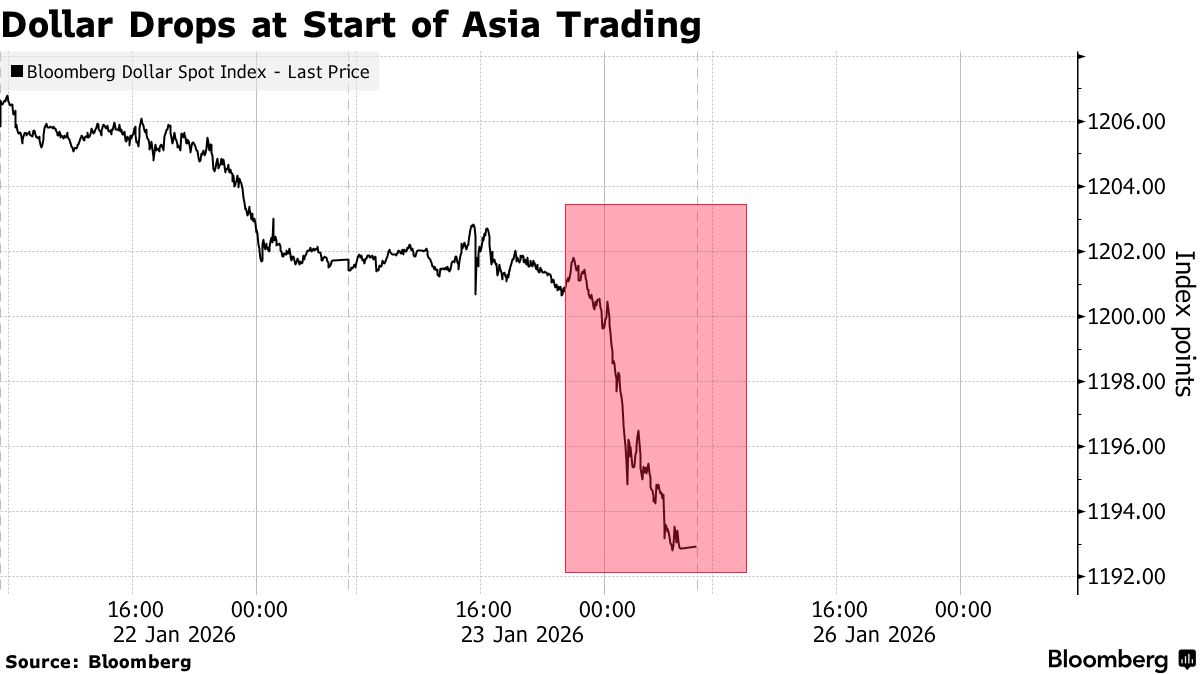
Dollar Pressure Mounts as Reasons for Further Weakness Multiply
The dollar weakened against most major peers Monday as investors debated how potential US involvement in foreign-exchange intervention in Japan might worsen sentiment toward the world’s reserve currency.
The yen strengthened almost 1% in early Asia trading against the greenback as speculation mounted over the weekend that Japanese authorities could be preparing to intervene to boost their embattled currency, perhaps with the joining in. Bloomberg’s gauge of the US currency fell as much as 0.3%, extending last week’s 1.6% decline.
For many dollar watchers, signs of US support to boost the yen re-opens the debate about potential co-ordinated currency intervention to guide the greenback lower against key trading partners. The thinking goes that such a pact would help American exporters compete with rivals such as China and Japan.
“The bigger signal is policy coordination,” said Daniel Baeza , senior vice president at Frontclear. “If markets interpret coordination as a willingness to tolerate easier global dollar conditions, especially alongside a dovish Fed reaction function, that could reinforce short-term dollar downside.”
Chatter reignited Friday when traders reported that the Federal Reserve Bank of New York had contacted financial institutions to ask about the yen’s exchange rate. Wall Street saw those inquiries as potentially laying the ground for Japan to intervene with help from the US.
Early last year, analysts debated the likelihood of a so-called , prompted by a research paper by Trump administration economist and now-Federal Reserve board member Stephen Miran on deliberately weakening the dollar.
Last week was the dollar’s worst since May after a week of unpredictable US policymaking rattled financial markets. President Donald Trump first brandished tariffs on Europe over his bid for Greenland, then abruptly dropped them. On Saturday, he threatened 100% tariffs on Canada if it reached a trade deal with China.
Risks around Federal Reserve independence and expectations that Chair Jerome Powell’s successor will be swayed by Trump to lower interest rates rapidly have also been weighing on the US currency. Bloomberg’s dollar gauge has fallen more than 9% since the beginning of last year.
Elsewhere on Monday, gold rose $5,000 an ounce for the first time. Precious metals are in the midst of a record rally as heightened geopolitical risks have added impetus to the so-called debasement trade, whereby investors retreat from fiat currencies.
“When the US Treasury starts making calls, it’s usually a sign this has moved past a normal FX story,” said Anthony Doyle , chief investment strategist at Pinnacle Investment Management. “The potential of coordinated action caps dollar-yen upside and makes the long dollar trade more fragile.”