China Greenlights Yuan Gains at Year-End With Measured Approach
China handed yuan bulls a New Year’s gift with tacit consent for more appreciation, while carefully pacing the currency’s gains to avoid hurting exporters and accelerating hot-money inflows.
The People’s Bank of China set the yuan’s daily reference rate on Wednesday at a fresh high since September 2024, a day after it allowed the currency to the key 7-per-dollar level in the more tightly controlled onshore market. That followed the yuan’s breach of the threshold in largely unrestricted offshore trading last week.
The reference rate implies that the PBOC is unlikely to stand in the way of a stronger yuan, paving the way for the currency to cap its biggest annual advance onshore since 2020. However, the fact that Wednesday’s reference rate came in well below the average estimate by traders and analysts in a Bloomberg survey suggests that policymakers remain committed to a gradualist approach to currency appreciation.
“The fix reinforced the measured pace of yuan appreciation bias” and alongside improvement in economic data, said Christopher Wong , a currency strategist at Oversea-Chinese Banking Corp. “Yuan bulls may see continued momentum going into 2026.”
The central bank boosted the reference rate, also known as the fixing, by the most in 15 months in December. It’s a closely watched policy tool as it defines the 2% trading band that confines the onshore yuan’s daily moves.
The stronger reference rate came before data China’s factory activity staged an unexpected recovery in December, snapping the longest slump on record and giving the economy a head-start into the new year.
Beijing is walking a tightrope by allowing slow yuan gains to appease trading partners while preventing sharp moves that may elicit a surge of speculative fund inflows. Although a stronger domestic currency can make China’s imports cheaper and aid authorities’ long-term goal of internationalizing the currency, risks of asset bubbles and financial instability weigh heavy on policymakers’ minds.
In its annual financial stability report released last week, the PBOC while it will maintain exchange rate flexibility, it will strengthen efforts to guide expectations and guard against “overshooting risks.” The People’s Daily, the Communist Party’s flagship newspaper, urged market participants to be rational with their currency expectations in an article on Wednesday, adding to a recent slew of reports that cautioned against making one-way bets on the yuan.
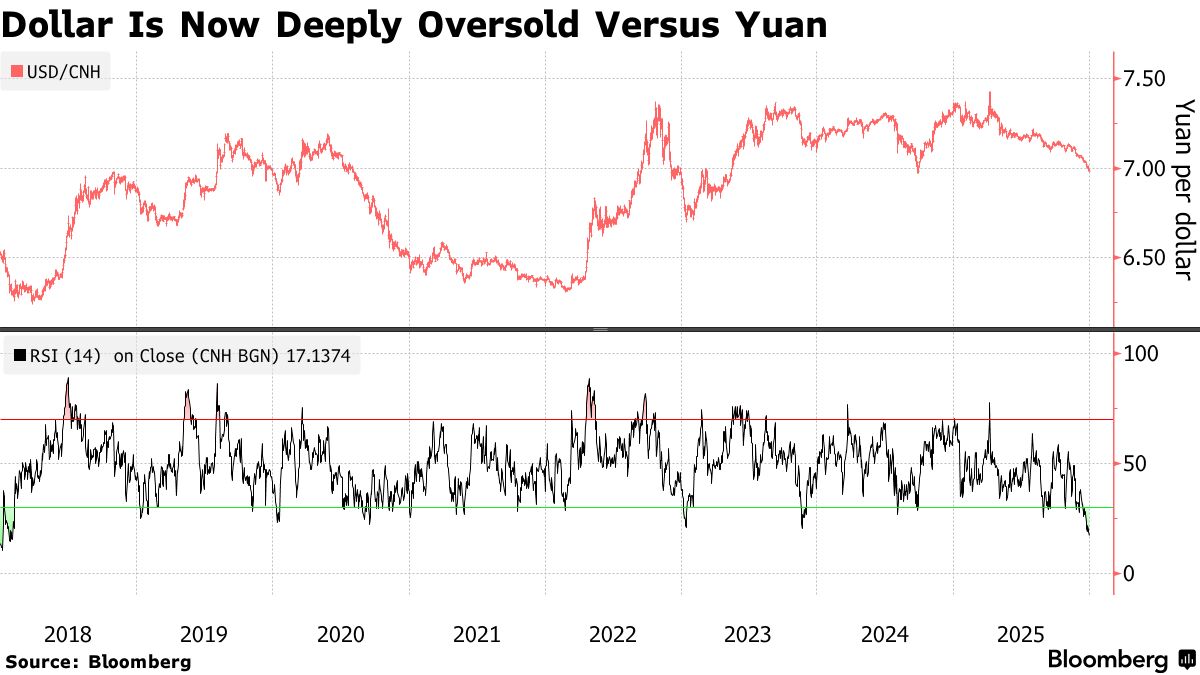
There are already signs that the yuan’s further advance may be a bumpy ride. For one, the dollar is now most oversold against the Chinese currency since 2018, the relative strength index of the pair shows. Traders also expect the yuan to see wilder swings, according to its one-month implied volatility .
Given the thin liquidity ahead of the New Year holiday, the momentum of yuan’s appreciation may continue and the dollar-yuan pair may test its low in September 2024, said Carie Li , a strategist at DBS Bank. “Once liquidity improves and seasonality abates, and coupled with the oversold signal of dollar-yuan, it means some reversal is possible ahead,” Li said.