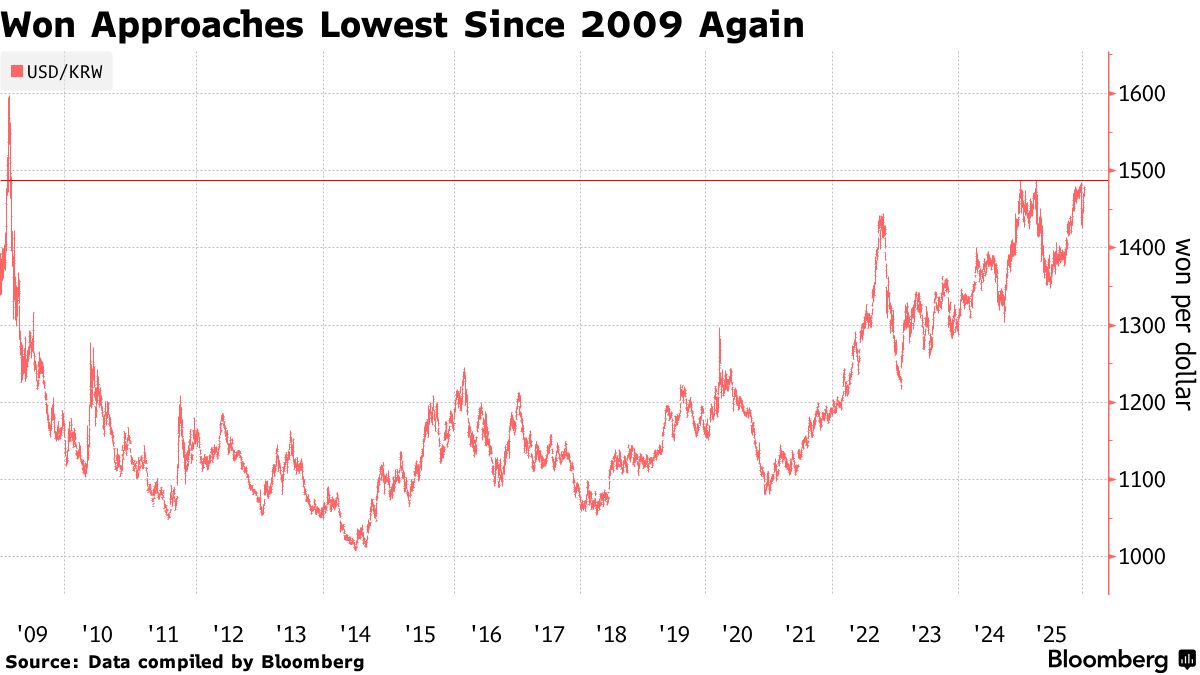
Won Nears 17-Year Low, Testing Korea’s Intervention Resolve
The South Korean won extended its decline toward its weakest level since the global financial crisis, intensifying pressure on authorities to defend the currency as local investors shift funds overseas.
The currency slipped as much as 0.2% on Wednesday to 1,478.25 won per dollar, on track for a ten-day losing streak and nearing its lowest level since March 2009.
Dollar demand in Korea has remained strong, fueled by local investors pouring into US equities and importers seeking the greenback for payments. Korean retail investors bought about $2.2 billion of US stocks through January 13, according to Korea Securities Depository data. Additional pressure on the won has come from foreign funds accelerating their selloff of Korean equities.
Despite authorities’ broad-based efforts to support the won late last year, the currency has also faced renewed pressure from external factors. Strong US economic data has boosted the dollar, while the yen has weakened amid early election headlines in Japan. Rising oil price concerns, driven by escalating tensions in the Middle East, have added another layer of strain.
In recent weeks, authorities intensified efforts to the won with verbal interventions and by waiving the foreign-exchange stability levy for banks. Yet these measures have done little to halt the currency’s slide, and markets are now focused on what further steps policymakers might take to counter a decline that risks fueling imported inflation and eroding consumer demand.
READ:
The won has fallen over 2.6% against the dollar this year, making it Asia’s worst-performing currency and one of the weakest globally.