Bessent’s Argentina Rescue Pledge Put to Test by Traders Attacking Peso

Treasury Secretary Scott Bessent ’s record as a powerful pacifier of unruly markets is now being put to the test in Argentina , where investors are questioning the value of his pledge of support last week for President Javier Milei .
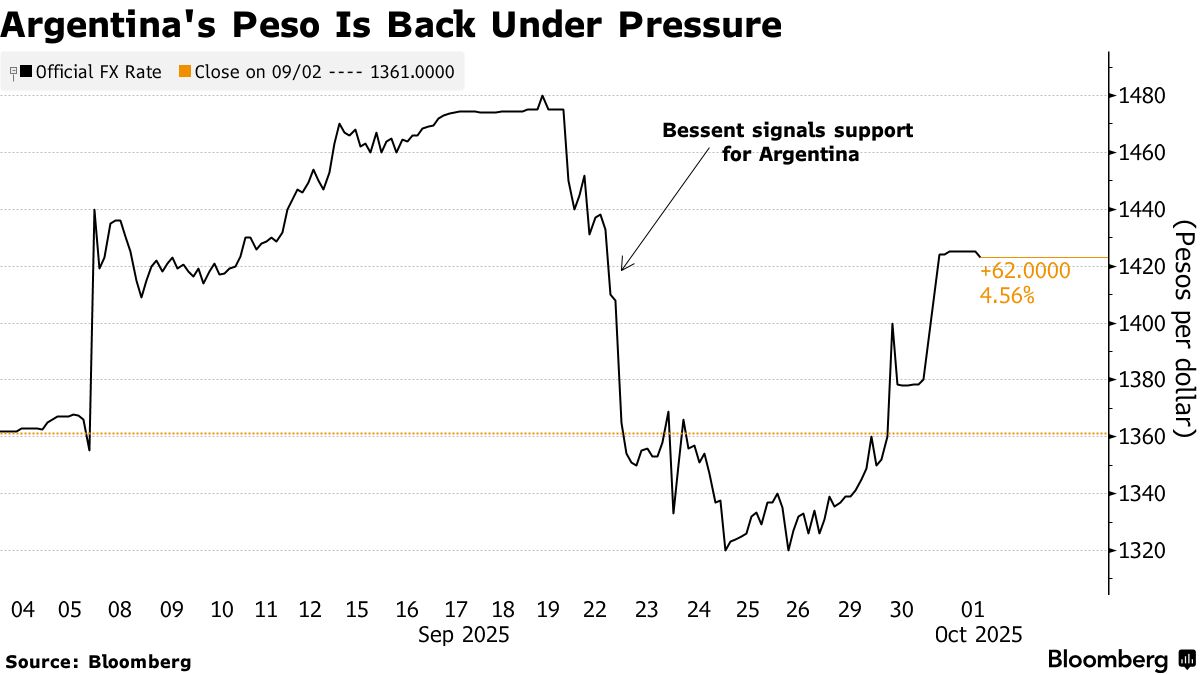
Barely a week after Argentine assets surged on a vow from Bessent “all options for stabilization,” traders Tuesday drove the Argentine peso down over 6% against the dollar — forcing Milei’s government to intervene and , only for it to fall again Wednesday and prompt by officials. The capacity of Buenos Aires to keep up such efforts on its own is limited by its lean foreign exchange reserves, putting a spotlight on what Washington is prepared to do.
“There’s a sentiment things can’t hold at this pace,” said Hans Humes , the chairman of Greylock Capital Management, who has more than three decades of experience with emerging markets. “The selling is led by locals, and dealers and investors here aren’t going to stand in the way,” New York-based Humes said.
The crisis of confidence stems from a poor showing of Milei’s party in a last month, and the US pledge was aimed at shoring up the Argentine ally of President Donald Trump before a bigger midterm election in late October. Investors are anticipating some major shift in foreign-exchange policy after those ballots, but the question now is whether the current framework can make it that far.
Milei himself said in a recent interview with local media that the US show of support is geopolitical. But what’s compounding the challenge for Bessent is that Washington is hardly united behind the effort.
Soybeans are a key reason why. American soy farmers have been locked out of their biggest export market — China — thanks to trade tensions, and their Argentine competitors have been stepping into the breach. That’s left some lawmakers uneasy about aid for Buenos Aires.
Senator Chuck Grassley , a senior Republican from Iowa, questioned why the US would “help bail out Argentina while they take American soybean producers’ biggest market???” in a last week. Senator John Hoeven , a North Dakota Republican, said Wednesday that help for Argentina is part of a “bigger relationship” the administration is working on with Argentina, and pointed to promises of help for American farmers from Trump, which the president reiterated in a Truth Social later in the day.
Bessent himself was captured in a photograph last week looking at what appeared to be a text from Agriculture Secretary Brooke Rollins expressing concern about the support for Argentina, CNN Tuesday, citing an Associated Press image.
The modern history of financial rescues shows that, sometimes, the announcement effect alone can be enough to stabilize a turbulent market. Then-Treasury Secretary Henry Paulson famously explained in July 2008 during the financial crisis, “If you have got a bazooka , and people know you’ve got it, you may not have to take it out.”
That was indeed the case with one Federal Reserve program during the spring 2020 Covid crisis. A primary corporate-bond support program with a half-trillion dollar limit , as confidence in US credit markets rapidly recovered.
But things aren’t heading that way with Argentina — where three different governments since 2018 have amassed $55 billion in debt over multiple bailouts from the International Monetary Fund that failed to stabilize the economy.
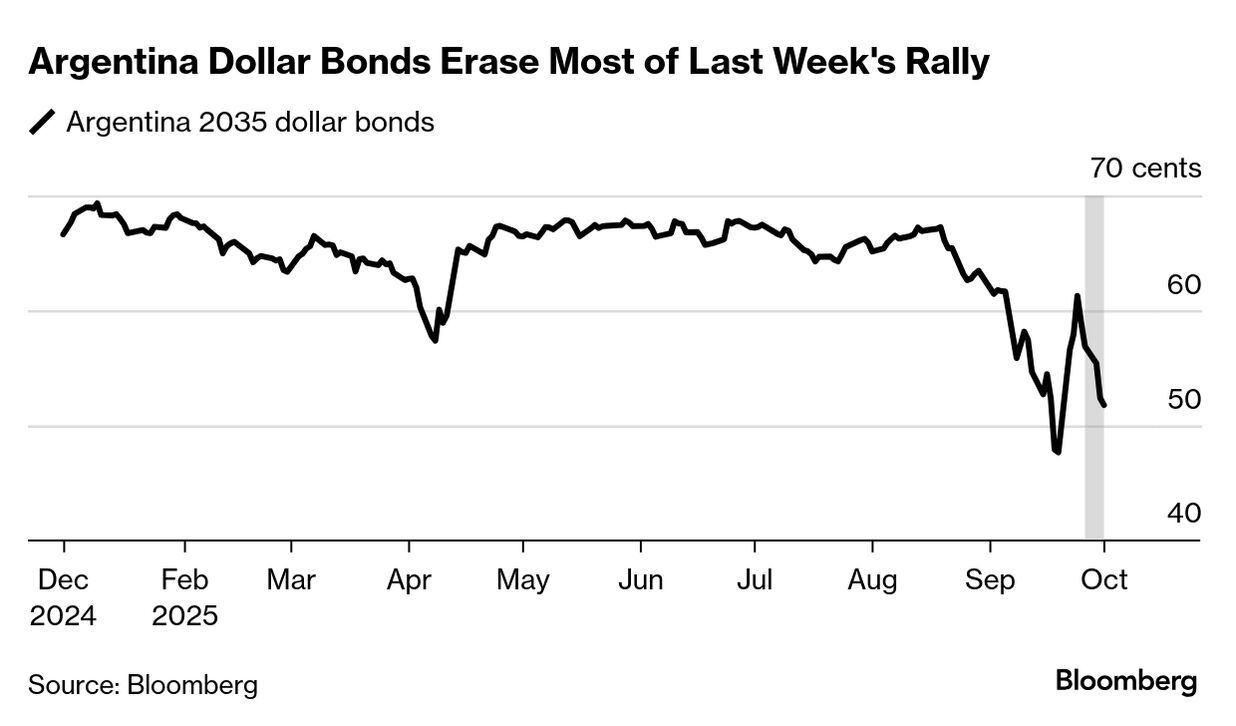
Some of the sovereign’s most-liquid dollar-denominated notes , maturing in 2035, have lost more than 5 cents in the past three sessions, erasing a large chunk of the gains registered after Bessent’s Sept. 22 pledge of support. The peso retreated further in Wednesday trading, and is now down around the 7% for the week so far.
An open question is how much it will take to stabilize the situation, and whether the elements Bessent outlined last week — in a social media post — will prove sufficient. The Treasury didn’t respond to a request for comment Wednesday.
“We need greater clarity on the US support package, particularly regarding its terms, conditionality and duration,” said Pedro Quintanilla-Dieck , a senior emerging-market strategist at UBS. “Further details on these aspects could unlock tactical upside for Argentina’s bonds from current depressed levels.”
Foreign-exchange swaps — one of the tools Bessent has referenced — proved an effective solution during times of crisis in 2008 and 2020 when there was sudden demand for dollar liquidity. But those were initiated by the Federal Reserve — which has effectively — rather than the Treasury, which faces constraints. The Fed has offered no public indication it’s part of the broader effort to aid Argentina.
There’s always the potential for something unexpected. Bessent has deep knowledge of the foreign exchange market from his decades-long career as a hedge fund manager, and a wide network of contacts in the financial industry. Back in the Asian financial crisis, then-Treasury Secretary Robert Rubin — a former co-head of Goldman Sachs — helped secure commitments from global banks to South Korean short-term credit, helping avert a bigger collapse.
Earlier this year, Bessent emerged as a key voice of assurance for Wall Street amid alarm over Trump’s plans for the most aggressive tariff hikes since before World War II. In a late-July interview, he argued that “I think I could have on Liberation Day,” referring to the April 2 unveiling of the steep levies.
Time will tell if Bessent’s skills will be enough to help Argentina stabilize.