S. Korea to Extend Won Trading to 24 Hours in Globalization Push
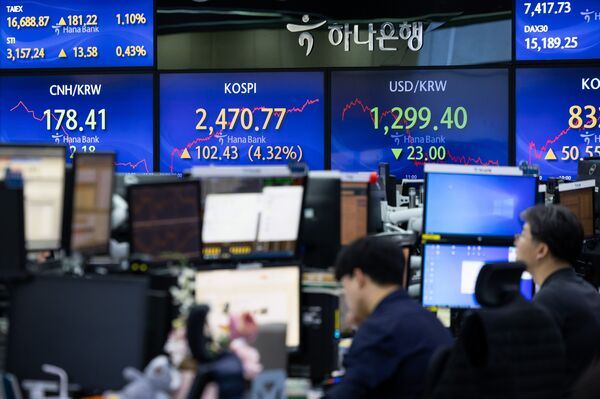
South Korea is moving to open its foreign-exchange market on a 24-hour basis and ease restrictions on won trading between non-residents, the Finance Ministry said.
The statement came after President Lee Jae Myung outlined his vision for Korea’s capital markets at a global investor-relations event in New York on Thursday, pledging efforts “to ensure that foreign investors can benefit from the ‘Korea premium’.” He stressed various measures to boost market transparency, improve corporate governance and reduce geopolitical risks.
Roughly one year after extending trading hours to 2 a.m. Seoul time, the government is now preparing to move toward round-the-clock trading “in a very short time”, Lee indicated. An MSCI roadmap is expected before year-end, the Finance Ministry said.
The move underscores Lee’s commitment to market reforms that will more closely align the country to international norms. A key challenge has been overcoming structural constraints in the FX market, seen as a prerequisite for South Korea’s inclusion in the MSCI Developed Markets Index for stocks.
Currently, non-resident won trading has been effectively limited due to reporting obligations and other regulatory hurdles. Planned legislative revisions would remove those barriers.
At the same time, the Bank of Korea intends to build a new settlement system capable of handling won payments on a 24-hour cycle.
In its June market-classification review, MSCI stressed that fully open currency convertibility is essential for Korea to qualify as a developed market. The report also highlighted the need for capital controls to be scrapped, deeper and more liquid onshore and offshore markets, and narrower bid-ask spreads.
Key features of advanced FX markets, MSCI noted, include broad participation from global investors, transparent real-time pricing, reliable and efficient settlement infrastructure, and broad access to hedging tools.
Korea’s incremental measures, such as limited trading-hour extensions, do not fully “reflect current practices in developed markets,” the index provider said at the time.