Trump Deal Threatens Won’s Advance as Dollar Demand to Surge
The South Korean won is under pressure as a $350 billion investment deal with the US is expected to drive huge dollar conversion demand in the coming years.
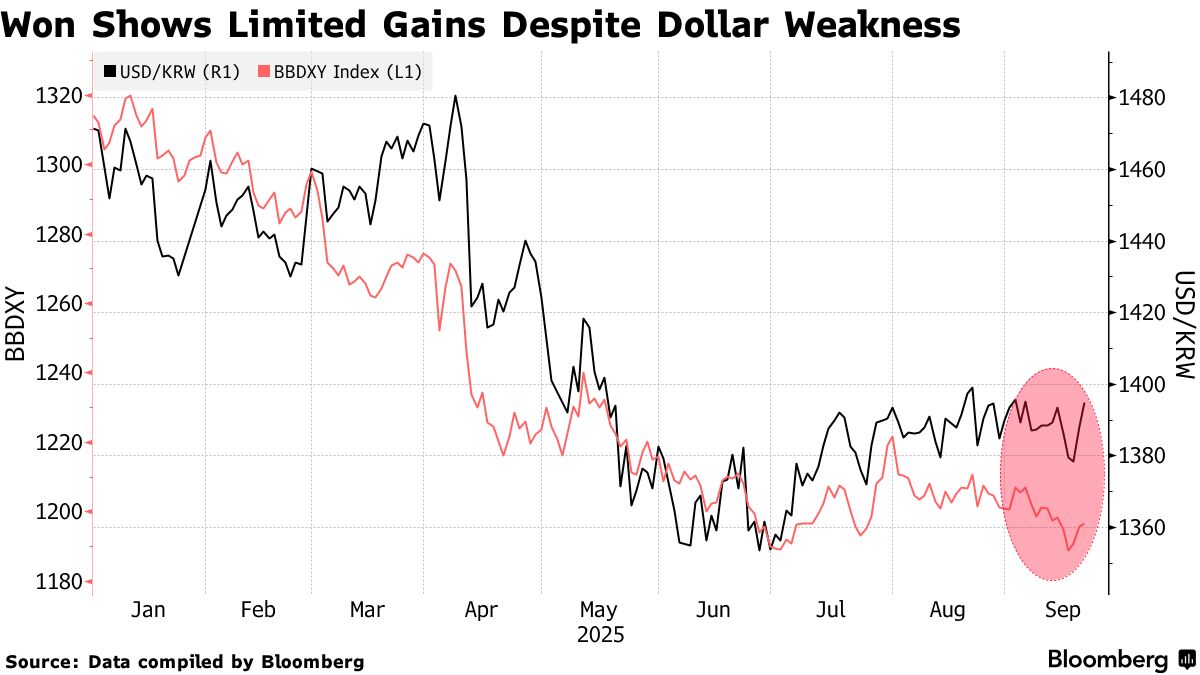
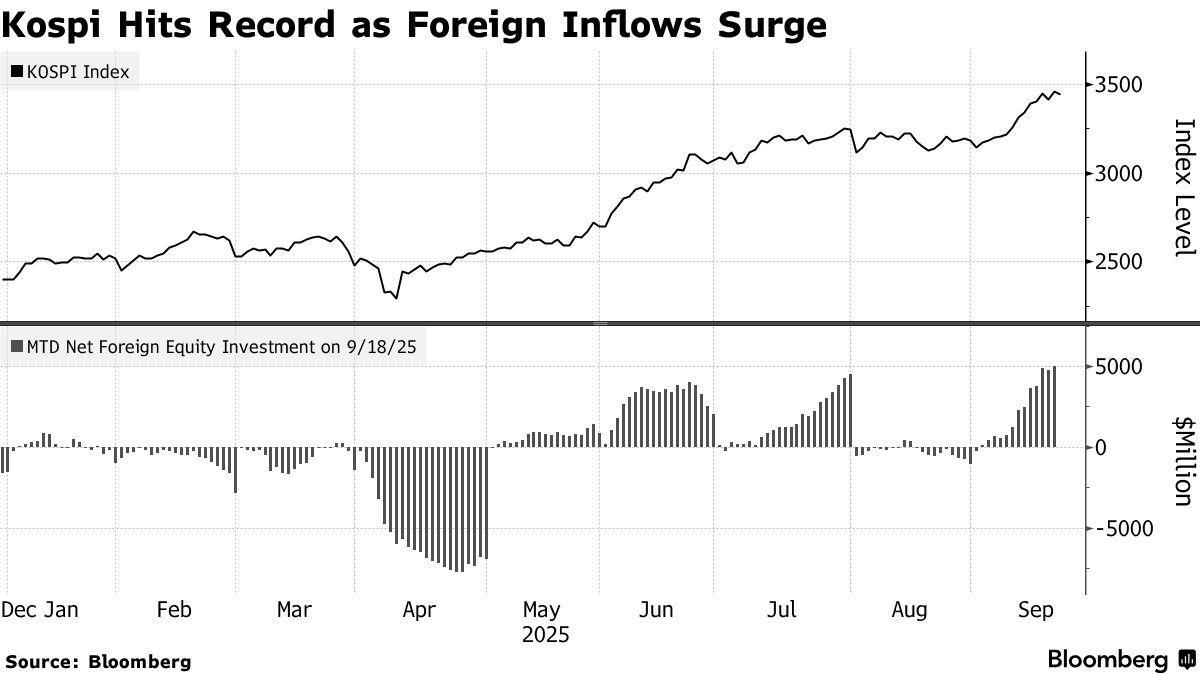
The currency had all the ingredients for a strong September as the Kospi hit a record high , foreign investors plowed in, and the dollar on the back of the Federal Reserve’s rate cut — yet the won has barely budged. Analysts at Citigroup Inc. and Societe Generale SA point to uncertainties around the US agreement as a key drag, with little on the deal’s structure besides the headline figure.
“Considering the substantial foreign equity inflows in September, USD/KRW should have declined further — potentially below 1,360,” Kiyong Seong , strategist at Societe Generale, wrote in a Thursday note. “One potential offsetting factor is market concern surrounding Korea’s planned $350 billion investment in the US.” The currency closed at 1,397.20 on Friday.
The won is Asia’s worst-performing currency in the second half after a robust start to the year. The 3% decline since the end of June comes even foreigners bought more than $8 billion of local equities during the period. SocGen’s Seong sees limited upside for the currency.
The won is still up more than 5% this year, which would be its first annual gain since 2020 if it holds up.
Ha Joonkyung, a senior presidential secretary, said in an interview with local media last week that the investment deal could become a “ ” in the currency market. Separately, Maeil Business Newspaper reported earlier that South Korea requested an unlimited currency swap with the US to mitigate the investment deal ’s impact on the won.
Read:
Citi economists estimate that the $350 billion in investment may need to be transferred to the US over three years, posing depreciation risks for the won, according to a Sept. 10 note. After accounting for foreign currency raised through public institutions’ bond sales, the resulting demand for dollar conversion could reach $96 billion a year — more than 200% of the national pension fund’s greenback demand, they wrote.
Still, strong equity inflow driven by Kospi gains and a solid current-account surplus are among factors keeping won bulls optimistic. Bank of America Corp. is holding on to its forecast for the won to end the year at 1,340 — roughly 4% stronger than Friday’s close.
“Although portfolio outflows are likely to continue, a weaker dollar following expected Fed cuts in September, together with strong foreign equity inflows and a decent current-account performance in the fourth quarter, can push the won stronger,” Chun Him Cheung , a strategist at Bank of America, wrote in a note before the US central bank’s decision.
The consensus forecast is more muted. Analyst forecasts compiled by Bloomberg see the won at 1,370 by year-end.
“As an export-dependent economy, Korea is vulnerable to trade disputes and tariffs” said Moon Hong-Cheol , an economist at DB Securities. “In such an environment, even broad dollar weakness may not translate into stronger won gains.”
This week’s main economic events: