TSMC’s Rise to Push Taiwan Past South Korea in Key Wealth Gauge
Taiwan is set to surpass South Korea this year in terms of wealth for the first time in over two decades, marking a shift in Asia’s economic ranks made possible by the ascent of
According to the latest forecasts released Thursday by Taiwan’s central bank, the island’s gross domestic product is expected to expand 4.55% in 2025, a further upward revision from the 4.45% estimate made by the statistics bureau in August.
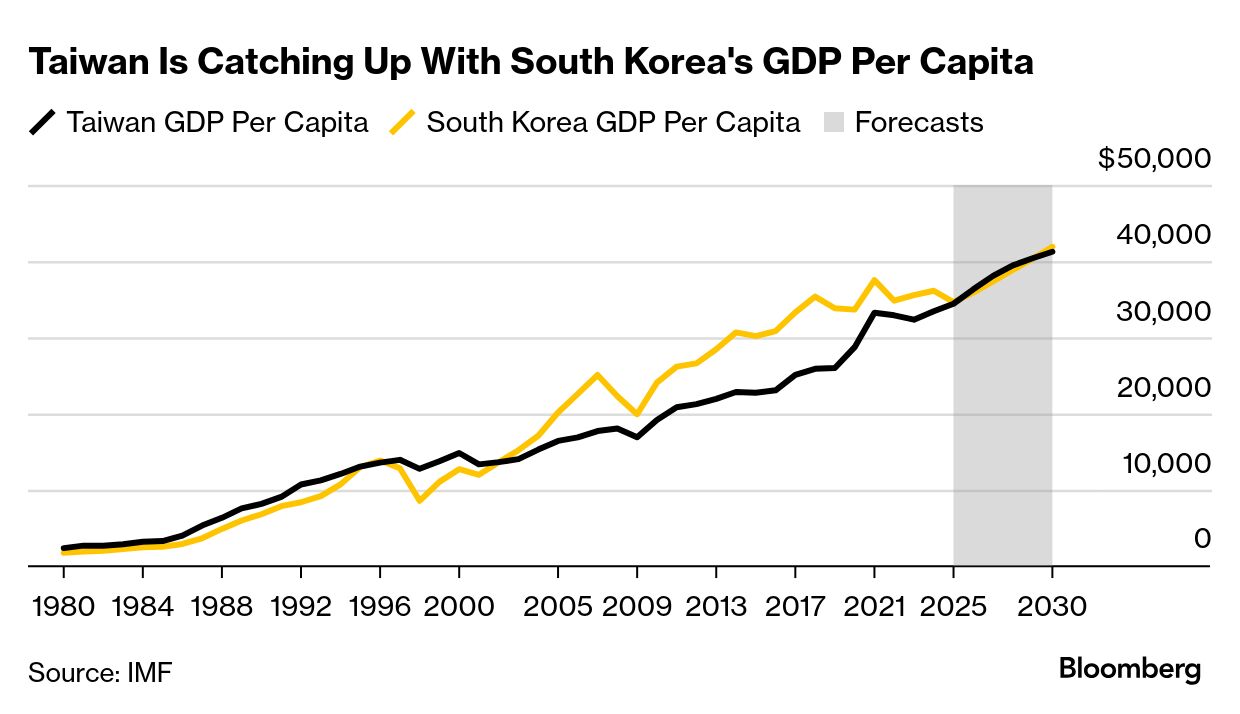
The growth trajectory puts Taiwan on track to exceed South Korea’s GDP per capita — a key measure of living standards — already in 2025, a year earlier than by the International Monetary Fund in April. While both are ahead of Japan, Taiwan with this year’s projected GDP per capita of just over $38,000 remains at less than half the level of Singapore.
Although skewed by the Taiwanese currency’s surge against the US dollar, Asia’s new pecking order offers another glimpse into how a global spending boom around artificial intelligence has transformed the economic fortunes of the self-governing island of 23 million people.
Taiwan saw its economy stagnate for decades after key manufacturers started to depart for China to take advantage of cheaper costs there starting in the late 1980s. But pandemic-era chip shortages vaulted its firms into global prominence, when state leaders and executives from the US to Europe scrambled to secure the semiconductors they needed to keep their economies humming.
The advent of ChatGPT then turbocharged that growth for TSMC and others like , which together assemble the majority of the world’s most advanced chips and servers essential to the development of AI. By contrast, , a conglomerate whose revenue is equivalent to about 11% of South Korea’s economy, has been struggling to catch up.
Global demand for high-end tech products from Taiwan and South Korea has kept them both relatively immune to the sweeping US tariffs imposed by Donald Trump .
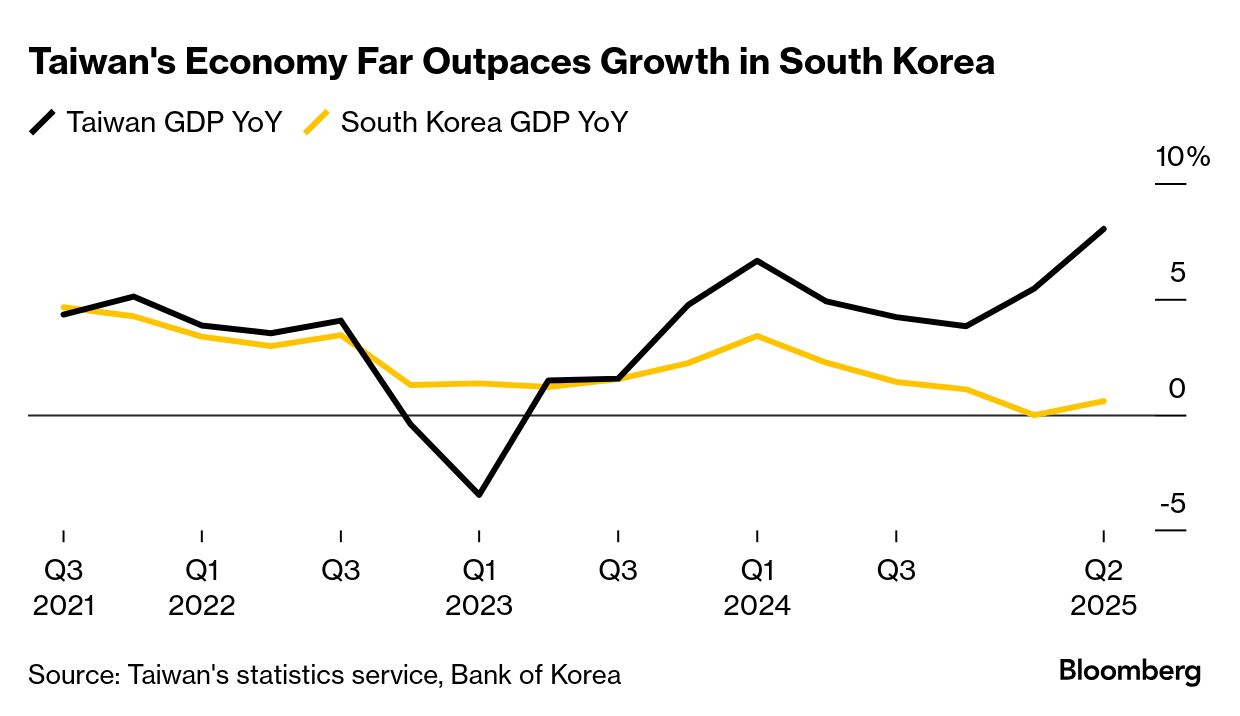
But whereas South Korea’s economy has stagnated, less than 1% from a year earlier in the second quarter, Taiwan clocked one of the world’s quickest growth rates with a gain of .
The Bank of Korea projects full—year growth at 0.9%. BOK Governor Rhee Chang Yong has repeatedly warned that structural challenges such as a low birthrate and an aging population are dragging the economy’s potential growth rate into the 1% range.
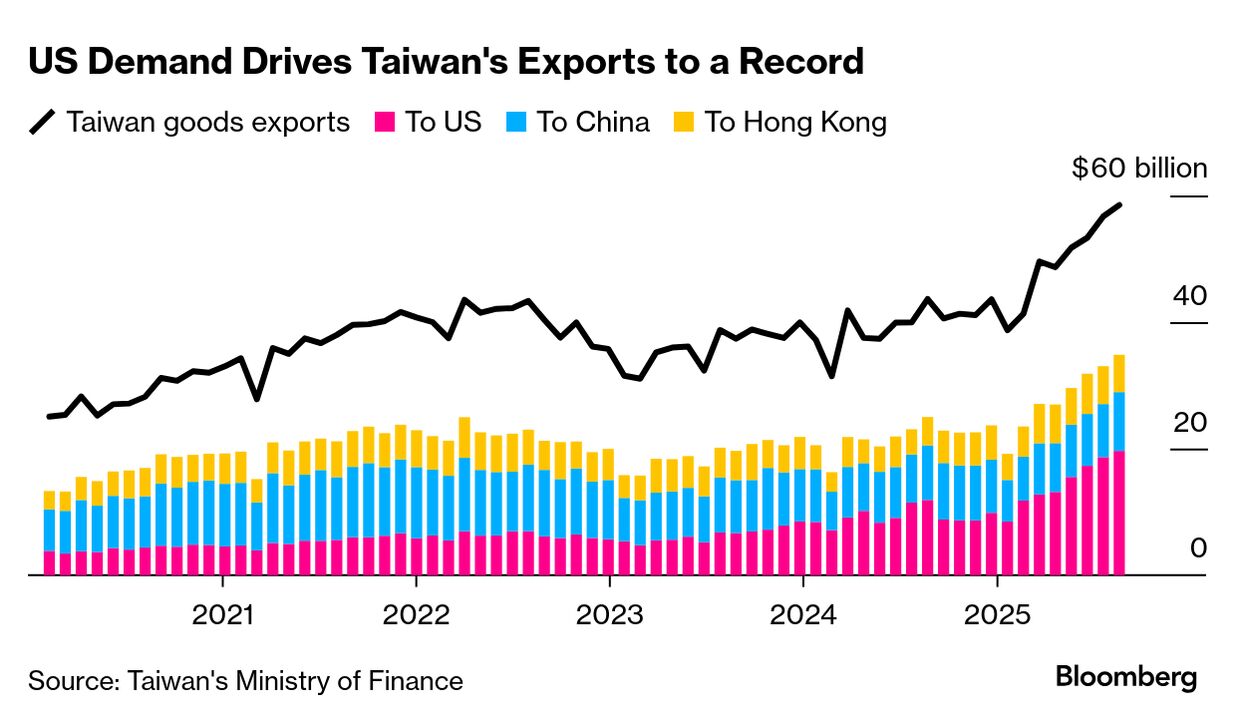
Taiwan’s dominance in products underpinning AI development has created boom times for its exports, which exceeded those of South Korea in August .
That milestone is especially telling given how South Korea’s population and overall GDP are more than double Taiwan’s size.
The rapid appreciation of Taiwan’s dollar this year is another factor that helps explain why the island’s GDP per capita has caught up so fast.
It’s the best performer among Asian currencies this year with a gain of around 9%, after exporters rushed to sell the greenback in part on expectations the authorities will allow it to strengthen to help reach a trade deal with the Trump administration. The South Korean won has gained just over 6% against the US dollar so far in 2025.
While the currency fallout has done nothing to slow tech powerhouses like TSMC, a stronger and more volatile exchange rate is a threat to Taiwan’s other, more traditional exporters.
Looking ahead, the worry for the economy is that its over-reliance on a single industry — with the US accounting for an ever-greater share of Taiwan’s exports — risks turning a strength into a vulnerability, especially at a time of geopolitical unease and tensions with China.
“Given limited resources, it is very hard for Taiwan to diversify to other industries,” said Woods Chen , chief economist of Yuanta Securities Investment Consulting in Taipei. “What’s needed is to transform traditional industries into suppliers for high-tech companies like TSMC. Then the government needs to figure out how to redistribute revenues generated from tech companies.”