Taiwan Insurers May Boost FX Hedging to Protect Foreign Assets
Taiwan’s life insurers look set to lift their currency hedging from near record lows in an attempt to shield overseas assets from further swings in the local dollar.
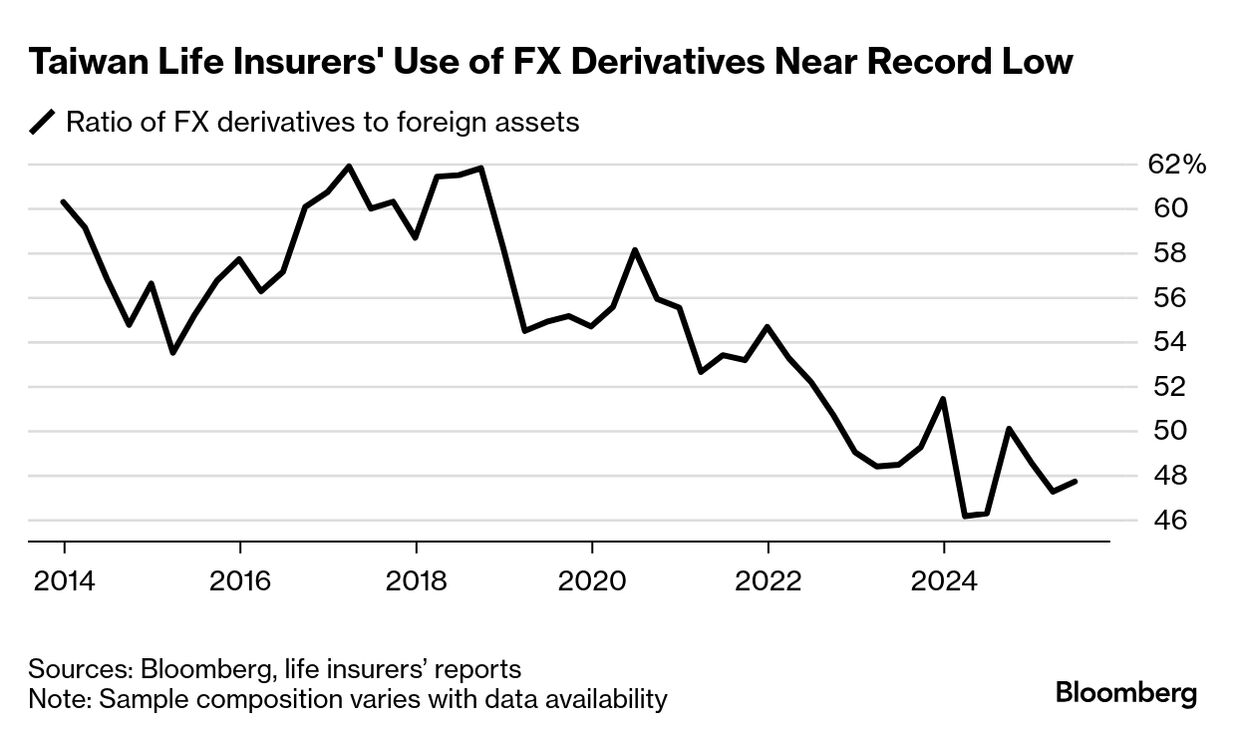
The island’s insurers hold more than $700 billion of foreign currency assets, making them a key source of demand for bonds issued overseas. But they had foreign derivatives equivalent to 47.7% of these assets by the end of June, near an all-time low, according to Bloomberg analysis of company presentations.
Taiwanese insurers were hit hard earlier this year, when the local dollar had its biggest since 1988. The relatively low use of derivatives now leaves room for insurers to ramp their hedging as traders brace themselves for another rally in the Taiwan dollar.
“With the expected start of Federal Reserve rate cuts in September, which is likely to lead to a decline in the dollar index, life insurers may further increase their hedges as they bet on a weaker dollar,” said Chandresh Jain , a rates and markets strategist at BNP Paribas SA.
More protection would allow insurers to push ahead with plans to increase exposure to overseas assets. Fubon Life Insurance Co. aim to add US bonds to back dollar-denominated policies and adopt a more flexible hedging strategy, while Cathay Life Insurance Co. is set to increase foreign bond allocations and lengthen currency swaps maturities.
Still, hedging remains expensive. Wagers on Taiwan dollar gains along with stronger demand for protection can drive up non-deliverable forward premiums. Life insurers faced a near 14% cost to hedge via NDFs back in May when the Taiwan dollar surged, Bloomberg-compiled data show.
Read More:
“By the time life insurers considered hedging, the cost had already become prohibitively expensive,” Jain said.
While that cost has now eased to around 3.5% last week, it still offsets the bulk of the yield on benchmark Treasury 10-year notes.
Many expect the Fed to resume easing rates this week, pressuring the dollar, with JPMorgan Chase & Co. forecasting an almost 7% gain for Taiwan’s currency by year-end. Focus will also be firmly on Taiwan central bank’s Sept. 18 policy decision , with fresh equity inflows adding to upside risks and fueling demand for hedging.
“Foreign inflows are currently the dominating factor,” said Wee Khoon Chong , senior Asia Pacific market strategist at BNY. “The US dollar is weak with prospects for Fed easing. Taiwan dollar valuations are no longer stretched as have been case in the past few months. All of these give clear green light for the Taiwan dollar to strengthen.”
This week’s main economic events: