Beaten Up Philippine Peso Set for Reprieve as Crude Retreats
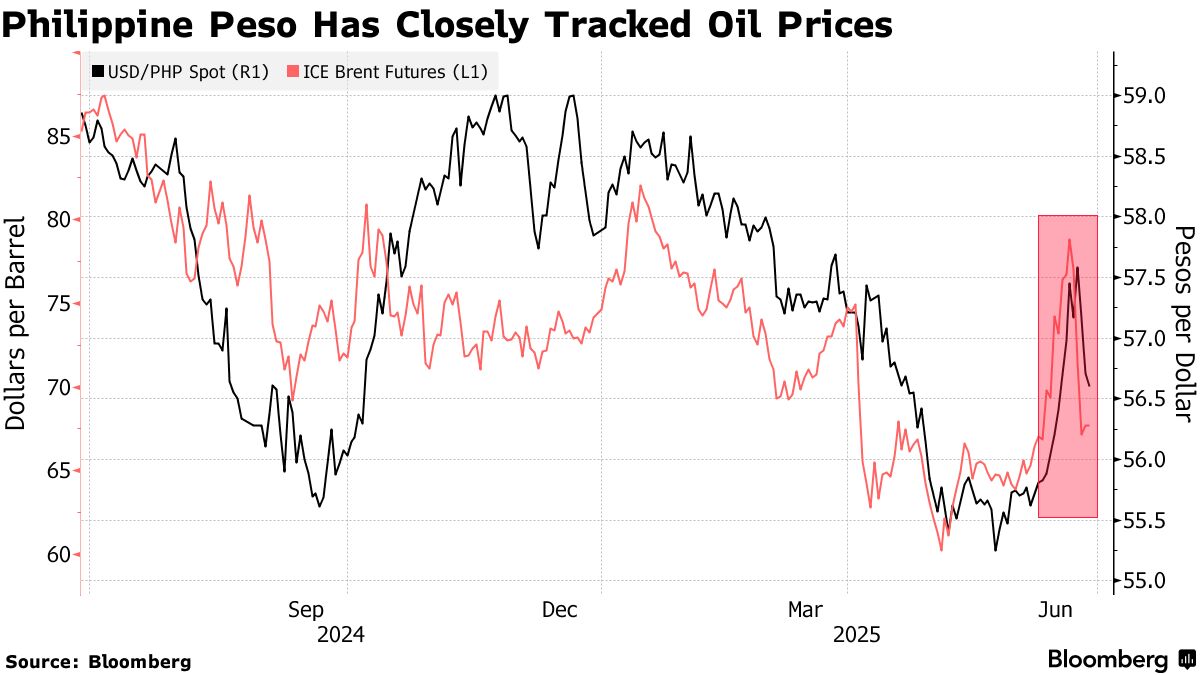
The worst may be over for the Philippine peso as falling oil prices boost the outlook for an economy that’s heavily reliant on oil imports.
The peso, which tumbled over 3% earlier this month before trimming losses, may end this quarter somewhere around its current level of 56.5 to the US dollar, according to strategists at Australia & New Zealand Banking Group Ltd., ING Financial Markets and Wells Fargo Securities.
The peso was battered earlier in April as the outbreak of the Israel-Iran war pushed up , worsening the outlook for economies such as the Philippines that are depended on energy imports. The ceasefire between the two nations has since seen the commodity come down about 15% from its highs.
“The peso’s advance is due to the reversal of oil prices,” said Wee Khoon Chong , a senior Asia Pacific market strategist at BNY in Hong Kong. “The normalization of crude oil prices is having a greater impact than domestic drivers such as dovish central bank and weakening growth outlook.”
Bangko Sentral ng Pilipinas this month cut its key interest rate for the second time this year and suggested there was scope for further easing as inflation was likely to remain modest. At the same time, policymakers said they remained about Middle East developments which may spur a sharper increase in crude costs.
Broad weakness in the US dollar has also helped the peso pare this month’s losses. The greenback has faltered amid concern over America’s fiscal deficits and also due to increasing expectations for Federal Reserve interest-rate cuts.
“Our rationale for dollar depreciation stems from a Federal Reserve that is likely to cut more than markets are priced for and a US economy that is likely to slow quicker than peer economies,” said Brendan McKenna , an emerging-market strategist at Wells Fargo in New York.
President Donald Trump has said US and Iranian officials will meet this week, helping to boost optimism that the conflict won’t escalate into a wider regional war.
“We expect the risk premium from the Middle-East tensions to dissipate which will lead to a slight recovery in the peso,” said Khoon Goh , head of Asia research at ANZ in Singapore. “Broad dollar weakness” should also support the currency, he said.
This week’s main economic events: