Brazil Lifts Interest Rate to 15% as Robust Economy Fuels Inflation
Brazil’s central bank raised its key interest rate by a quarter-point and signaled borrowing costs will likely remain steady for a long period as board members gauge the impact of tight policy on inflation and activity.
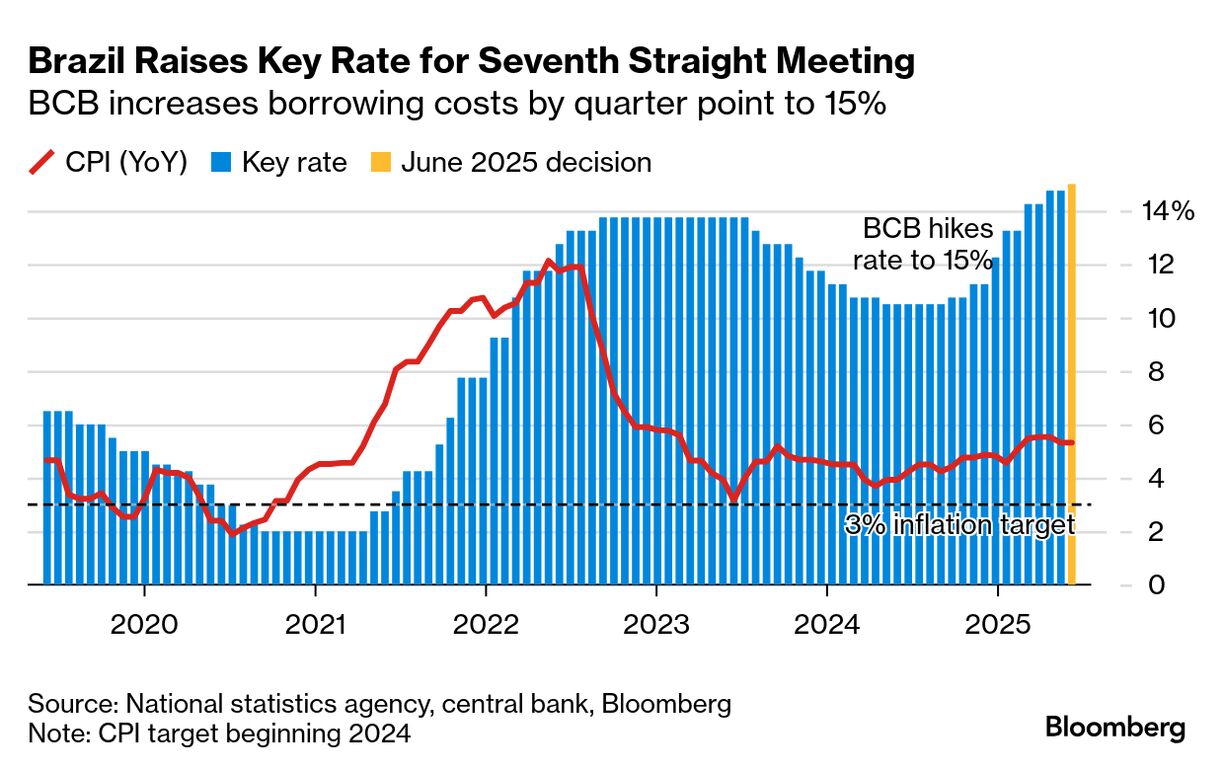
Central bankers led by Gabriel Galipolo lifted the benchmark to 15% in a unanimous decision on Wednesday, as expected by 12 of 32 economists in a Bloomberg survey. The other 20 saw borrowing costs steady at 14.75%.
Policymakers wrote in a statement that headline and core inflation are running above target, the economy is resilient and the labor market is generating price pressures. In that context, the central bank needs “significantly contractionary monetary policy” to anchor cost-of-living forecasts.
“If the expected scenario materializes, the Committee foresees an interruption of the rate hiking cycle to examine its yet-to-be-seen cumulative impacts,” policymakers wrote . The board said it will “evaluate whether the current interest rate level, assuming it’s stable for a very prolonged period, will be enough to ensure the convergence of inflation to the target.”
At the same time, policymakers said future steps can be adjusted, and the highest rates in nearly two decades can be raised even further if needed.
Brazilian central bankers have now delivered seven straight rate hikes totaling 4.5 percentage points since last September. They extended their tightening cycle as inflation forecasts run well above the 3% target through 2028. While global trade uncertainty poses a risk to growth, factors including low unemployment and government spending are underpinning domestic activity.
“The central bank set a very high bar to raise rates again,” said Solange Srour , head of Brazil macroeconomics at UBS Global Wealth Management. “The quarter-point hike was aimed at supercharging its credibility.”
Read more:
Brazil’s decision came hours after the Federal Reserve , saying economic uncertainty was still high but had diminished.
The rate hike announcement also followed hawkish remarks from Galipolo, who said earlier this month that economic activity is “surprisingly resilient” and that the central bank needs to stay strong in the face of pressure.
Next Year
Brazil’s gross domestic product 1.4% in the first quarter on bumper crops and strong family consumption. More recently, the economy a modest 0.16% in April, according to the central bank’s main gauge of activity.
In their statement, central bankers said there is some moderation in growth. The global environment remains adverse, and the outlook requires caution from emerging-market economies amid geopolitical tensions, they wrote.
“Signs of moderation in the economy are already here,” said Rafaela Vitoria , chief economist at Inter, adding that she still expects a rate cut by year’s end. “From now until December is prolonged enough, and it’s going to be painful.”
While snapped three months of gains in May, slowing more than expected to 5.32%, it remained above the 4.5% ceiling of the central bank’s tolerance range. Policymakers see inflation slowing to 4.9% in 2025 and 3.6% in 2026, according to the statement.
What has worked in the central bank’s favor is Brazil’s currency, the real , which has surged nearly 13% against the dollar so far this year. A stronger exchange rate helps to tame the cost of imports.
Read more: Brazil´s Residual Rate-Hike Help Propelling BRL Toward 5.40/USD
Separately, Brazil’s government will try to persuade lawmakers not to block its proposed hike to a financial transaction tax known as the IOF. Many economists argue that higher levies on loans could help monetary policy cool the economy.
Central bankers reiterated in the statement that they will monitor fiscal developments very closely.
Put together, holding the Selic at 15% until the middle of next year would put inflation within the tolerance range in 2027, according to Caio Megale , chief economist at XP.
“The central bank practically closed the door to new hikes,” Megale said. “But, it emphasized that borrowing costs will remain high for a very prolonged period. It was a hawkish statement in absolute terms.”